Quick Summary: EHR software development in 2026 means building a longitudinal, interoperable patient record system, not a digital filing cabinet. It requires FHIR and HL7 compliance, HIPAA-grade security, and a modular architecture. Costs range from $80,000 for MVPs to $500,000+ for enterprise builds, depending on scope and integrations.
A cardiology group outside Nashville spent eighteen months trying to bolt a telehealth module onto a decade-old system. Eventually they gave up and started over. That story plays out across healthcare more often than most vendors like to admit.
As of 2024, 91% of office-based physicians in the United States had adopted a certified EHR, with non-federal acute care hospitals reaching near-universal adoption, according to ONC data tracking the rapid digitization of patient care over the past decade. Adoption stopped being the challenge years ago. Fit is the challenge now. A platform built for general practice rarely serves a specialty clinic well, and software designed five years back rarely clears today’s interoperability bar.
This guide walks through what actually matters in EHR software development for 2026, including architecture choices, compliance requirements, realistic costs, and how to decide between building custom or buying off the shelf. Many organizations bring in a software development company at exactly this stage, before scope gets locked in and assumptions harden into requirements.
Building an EHR isn’t like building a typical business app. Every screen touches patient safety. Every field carries a regulatory implication somewhere. Rushed integration points tend to surface as failures months later, usually during an audit nobody scheduled for this reason.
The shift underway right now moves records from siloed, single-clinic charts toward longitudinal systems that follow the patient across settings. That distinction matters more than it sounds on paper. A closer look at the difference between EHR and EMR systems explains why the two get confused constantly, and why getting the distinction wrong early reshapes your data model later. This single change ripples through consent architecture too, and through every decision that follows in EHR development.
Three forces are pushing this in 2026:
None of this is optional. A platform that ignores these pressures looks outdated within a year of launch, sometimes sooner.
This is where most teams stumble, usually because they pick based on budget alone rather than fit.
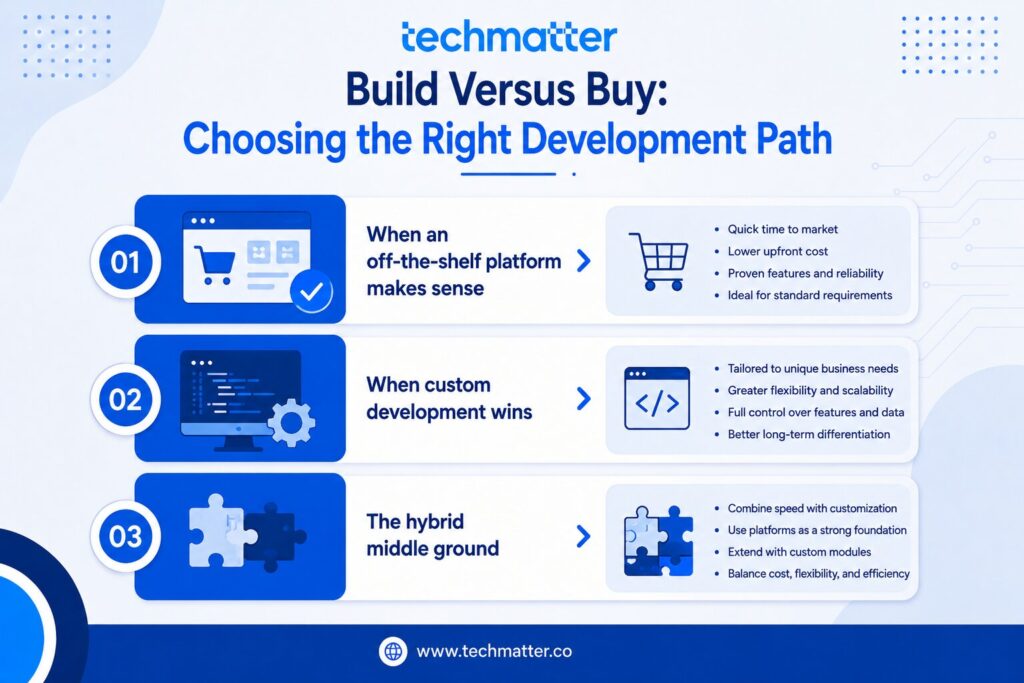
Standard workflows. Tight timelines. Limited internal engineering capacity. All three point toward a commercial product. Primary care and general ambulatory clinics without unusual documentation needs get compliant faster with a certified vendor platform than with a from-scratch build, and that speed carries real value when regulatory deadlines are close.
Specialty care changes the math entirely. Oncology, behavioral health, fertility, and home health all carry documentation patterns that generic EHRs handle badly. Custom EHR system development lets you encode those workflows directly instead of forcing clinicians around software that was never built for them in the first place.
Plenty of organizations start with a certified core and layer custom modules around it. This keeps the regulatory backbone intact while giving product teams room to build the pieces that actually differentiate the product. Patient engagement tools. Specialty documentation. Analytics dashboards. None of it touches the certified base underneath.
Picking wrong here gets expensive fast. Teams that choose off-the-shelf for a highly specialized workflow often end up paying for endless customization that a custom build would have handled more cleanly from day one.
Regardless of the path, a handful of capabilities are no longer optional. This is the baseline, not the differentiator.
Skip any one of these and the friction shows up later. Usually during a payer contract renewal, when it’s expensive to fix.
Technology decisions made at the start tend to outlive the people who made them. A modular, service-oriented architecture separates scheduling, documentation, billing, and analytics into components that update independently, rather than one tangled monolith nobody wants to touch.
Backend teams commonly work in Java, .NET, Python, or Node.js. The choice matters less than team familiarity and how well the tooling supports interoperability standards. Frontend frameworks like React give clinicians the responsive interfaces that cut click fatigue during a twelve-hour shift, which adds up over a career.
Cloud hosting through AWS, Azure, or Google Cloud offers elasticity. Some regulated environments still require hybrid or on-premises setups instead, and that’s a fair tradeoff in certain cases. Either way, design for future migration now. A rewrite later costs far more than planning for it up front ever does.
| Approach | Best fit | Typical timeline |
| Off-the-shelf | Standard workflows, fast compliance need | 2 to 4 months |
| Hybrid | Certified core plus custom modules | 4 to 8 months |
| Full custom build | Specialty care, differentiated product | 9 to 18 months |
Budgets for ehr application development vary widely, but a few patterns hold across most projects. A minimum viable product covering registration, scheduling, and basic documentation typically lands between $80,000 and $150,000. Full enterprise builds with deep interoperability and advanced analytics regularly exceed $500,000, sometimes by a wide margin.
Integration work gets underestimated constantly. Connecting to labs, imaging systems, pharmacies, and payer portals adds real engineering hours that rarely show up in early estimates. Ongoing maintenance and regulatory updates should be budgeted as a permanent line item, not a one-time cost that disappears after launch.
Working with a healthcare-focused development team that understands HIPAA and interoperability from the outset tends to cut rework significantly compared to teams learning those constraints mid-project. That upfront cost almost always pays for itself before year two.
Getting EHR software development right in 2026 comes down to matching architecture to how care actually gets delivered, not chasing whatever framework happens to be trending. Start with a clear scope, pick a partner who has shipped healthcare software before, and treat the first release as a foundation rather than a finished product. TechMatter works through these tradeoffs with healthcare organizations regularly, and the conversation is usually most useful before scope gets locked in.
1. How long does EHR software development typically take?
A minimum viable product with core scheduling and documentation usually takes 4 to 8 months. Full enterprise deployments with deep interoperability and multi-department rollout often run 12 to 18 months, depending on integration complexity.
2. What is the difference between an EHR and an EMR?
An EMR is a digital chart used within one practice. An EHR is a longitudinal record that follows a patient across multiple providers and care settings. EHRs are built for interoperability using standards like FHIR and HL7. EMRs typically aren’t.
3. How much does custom EHR development cost?
Custom builds typically range from $80,000 for a focused MVP to over $500,000 for enterprise-grade platforms with full interoperability. Cost depends heavily on the number of integrations, specialty workflows, and compliance requirements involved.
4. Do EHR systems need to be HIPAA compliant?
Yes. Any EHR handling protected health information in the United States must meet HIPAA requirements, including encryption, access controls, and audit logging. Non-compliance risks real fines and lost trust from patients and partners alike.
5. Should a small clinic build a custom EHR or buy an existing one?
Small clinics with standard workflows generally do better with an off-the-shelf certified EHR. It gets them compliant faster at lower upfront cost. Custom development starts making sense once documentation needs or growth plans outgrow generic software.


IT Solutions and Managed Services Provider specializing in developing custom solutions.
 +1 (781) 667-5321
 info@techmatter.co
 100 N Brand Blvd Suite 522, Glendale, CA 91203, USA