Quick Summary: Custom software development cost in 2026 usually falls between $30,000 and $500,000. It depends on compliance needs, feature scope, and integration work. A basic scheduling tool sits near the low end. A full EHR with AI features and multi-facility support sits near the top. Budget for testing, migration, and support after launch too.
Three vendors, one project, three wildly different quotes. A practice manager sees this constantly, and the gap can run past $200,000 for what looks like the same build on paper. Software development cost swings this hard because two products that sound identical rarely carry the same compliance load or the same integration list. A basic patient portal is nothing like a claims engine wired into five insurance payers. Knowing what actually moves the price tag matters more than chasing one clean number.
Below is where the money goes, what pushes it up or down, and how to build a budget that survives contact with a real vendor conversation.
Healthcare software carries baggage that a retail app never has to think about. HIPAA compliance alone means encryption, audit logging, and access controls, and none of that is quick to build correctly. Then there’s the data. Patient records, claims, lab results. All of it has to move safely between systems, and integration work almost never goes as fast as anyone hopes going in.
Team location changes the math too. A US-based team might bill $150 to $250 an hour. Offshore teams with real healthcare experience often run $40 to $90. Neither is the wrong answer by default. It comes down to how much oversight a project needs and how tight the deadline is. Feature scope still moves the needle more than anything else on this list. Five screens cost far less than twenty, and every workflow added on top multiplies testing time right alongside build time.
The type of tool being built shapes the invoice more than almost anything discussed so far. So does the number of systems it has to talk to. Four categories come up again and again in healthcare software conversations, and each one has its own price logic. For a broader walkthrough of how these builds come together end to end, this guide to medical software development covers the process in more depth.
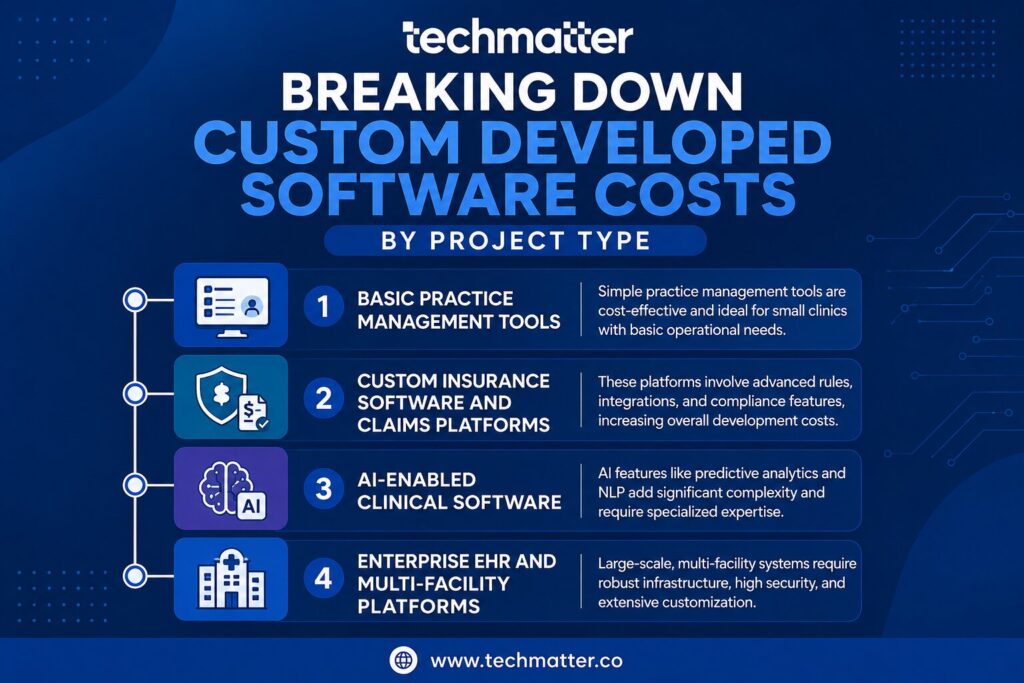
Basic practice management software includes features like scheduling, patient messaging, and reporting. These solutions sit at the affordable end of custom software development, typically costing $30,000 to $75,000, and often rely on pre-built components to reduce development time. A small clinic replacing a clunky spreadsheet usually lands right here. The catch: “basic” still means HIPAA-compliant handling from day one. Bolting that on later almost always costs more than building it in from the start.
Custom insurance software and claims platforms handle claims processing, eligibility verification, and payer integrations. Projects for a regional payer or a multi-specialty billing company often cost $150,000 to $400,000. The complexity comes from connecting to multiple clearinghouses, each with its own format and validation rules. One mismatched field can delay reimbursement on thousands of claims, so testing takes longer here than most people expect.
AI-enabled clinical software can include ambient documentation, predictive risk scoring, and AI-assisted medical coding. Building these solutions commonly costs $150,000 to $300,000 or more because model training and validation add another layer of complexity beyond standard development work. Data pipelines need careful handling, and clinical AI faces more scrutiny than a typical consumer tool. Leave room in the timeline for validation against real patient scenarios before anything goes live.
Enterprise EHR platforms support multiple locations, providers, and large volumes of patient data, making them the most expensive type of healthcare software to build. A full EHR can cost $500,000 to $2 million. Migration from an old system adds another $15,000 to $90,000, depending on how much historical data has to move. Organizations building at this scale should plan on 12 to 18 months, not less, and budget accordingly from the first conversation.
Numbers side by side make budgeting easier than reading them scattered across paragraphs. Here’s how 2026 pricing typically breaks down across three common tiers.
| Project tier | Typical cost | Timeline |
| Basic tool (scheduling, portals) | $30,000 to $75,000 | 3 to 4 months |
| Mid-complexity (billing, claims, AI features) | $150,000 to $400,000 | 6 to 9 months |
| Enterprise EHR or multi-facility platform | $500,000 to $2,000,000+ | 12 to 18 months |
The averages back this up too. Clutch’s own 2026 pricing data, drawn from verified client reviews, puts the average software development project at $132,480 with a typical delivery timeline of 13 months, according to its software development pricing guide. That average sits well inside the mid-complexity range above, since most reviewed projects fall short of the compliance and integration work a full healthcare build requires.
Everyone forgets the line item for what happens after launch. A few costs show up almost every time, and none of them are optional in practice:
Skip that budget line and the software starts falling behind within a year. Skipping discovery is where most overruns start, and by the time anyone notices, the fix is rarely cheap.
Custom software development pricing gets easier to manage once a healthcare organization treats the budget as a range tied to clear cost drivers, not a fixed number handed down by a single vendor. Teams that plan for compliance, integration, and post-launch support from the start avoid most of the surprises that derail a project halfway through. TechMatter works through exactly this kind of planning with healthcare organizations, from early discovery through build and long-term support. Whatever tier a project lands in, lock down scope and compliance requirements before requesting quotes, not after.
1. How much does custom software cost for a small medical practice?
A small practice building basic scheduling or patient messaging tools should expect $30,000 to $75,000. Costs rise if the practice later adds custom insurance software or EHR integration on top of the original build.
2. Why do software development quotes vary so much between vendors?
Quotes vary because vendors price compliance, integration complexity, and team location differently. A US-based team billing $200 an hour quotes higher than an offshore team, even for the same feature list.
3. What is the cheapest way to build healthcare software?
Starting with an MVP is the cheapest realistic approach. Building only the core feature first, testing it with real users, then expanding later cuts wasted spend on features nobody ends up using.
4. How long does it take to build custom healthcare software?
Basic tools take 3 to 4 months. Mid-complexity platforms with billing or AI features take 6 to 9 months. Full EHR systems for multiple facilities often take 12 to 18 months to complete properly.
5. Do healthcare software costs include compliance and security?
Not always, and that’s the problem. HIPAA compliance, encryption, and audit logging need to be built in from the start. Adding them after launch almost always costs more than including them upfront.


IT Solutions and Managed Services Provider specializing in developing custom solutions.
 +1 (781) 667-5321
 info@techmatter.co
 100 N Brand Blvd Suite 522, Glendale, CA 91203, USA