Digital health systems are reshaping how care is delivered, managed, and scaled across medical environments. For healthcare leaders, clinic owners, and IT professionals, understanding the difference between an Electronic Health Record (EHR) and an Electronic Medical Record (EMR) is more than a technicality; it’s a strategic decision with long-term impact.
The systems you choose today will determine how well your organization performs tomorrow. At Techmatter Global, we work with medical practices, hospitals, and healthcare startups to help them make smarter choices when it comes to electronic medical record systems and scalable EHR infrastructures.
Regardless of your plans to enhance your current EMR or switch to an enterprise-grade EHR, this article explains the differences, applications, and how to pick the best option for your business.
While the terms EHR and EMR are often used interchangeably, they serve different purposes and audiences.
At first glance, the difference seems subtle. But for decision-makers in clinics and hospitals, understanding this nuance is crucial. Choosing the right system can lead to improved patient outcomes, higher efficiency, and long-term cost savings.
An electronic medical record is a software tool used within a single healthcare organization to store and manage patient data. It includes medical history, diagnoses, medications, allergies, lab results, and treatment plans.
Yet, the primary limitation of EMRs lies in data sharing. They are typically confined to one provider’s system, meaning that when a patient moves to another clinic, their data doesn’t move with them unless manually transferred. That’s where EHRs take the lead.
Electronic Health Records represent the next level of digital healthcare. While an EHR contains all the information found in an EMR, it is designed for data interoperability. This means it supports seamless information exchange between various healthcare providers, labs, pharmacies, and even insurance platforms.
For healthcare executives, IT administrators, and clinic owners, understanding the difference isn’t just academic; it’s a business decision. Here’s why:
Because EHRs provide doctors access to a patient’s whole medical history, regardless of where they have previously received treatment they can make better judgments.
If your organization is expanding or plans to offer multi-specialty services, EHRs offer the flexibility to scale. EMRs, while efficient, can become bottlenecks during growth.
Practices that implement EHRs might get incentives from government programs like Meaningful Use and MIPS. Financial fines may be imposed for failure to adopt compliance systems.
Modern patients demand transparency and access. EHRs offer tools like patient portals, online appointment booking, and test result notifications, all key to retention and satisfaction.
If you’re a clinic, hospital, or healthcare startup aiming to digitize your practice, your choice of system will define your efficiency, data security, and patient trust for years to come.
Our specialty at Techmatter Global is helping you navigate the difficult process of deciding between full-featured EHR platforms and electronic medical record solutions. In addition to making suggestions, we also integrate, optimize, and deploy your systems for sustained performance. Our team makes sure your solution, whether you’re implementing a new EHR or updating an old one, is:
Dr. Lena’s Family Practice uses an electronic medical record system to manage appointments, prescriptions, and lab requests all within a single clinic. It’s efficient, low-cost, and meets her clinic’s needs.
However, Dr. Lena’s EMR is inadequate when she collaborates with a hospital group to increase services. The hospital has a full-featured EHR system that facilitates real-time departmental updates, lab connections, and specialist referrals. To align Dr. Lena upgrades to the EHR, enabling better interoperability and patient interaction options.
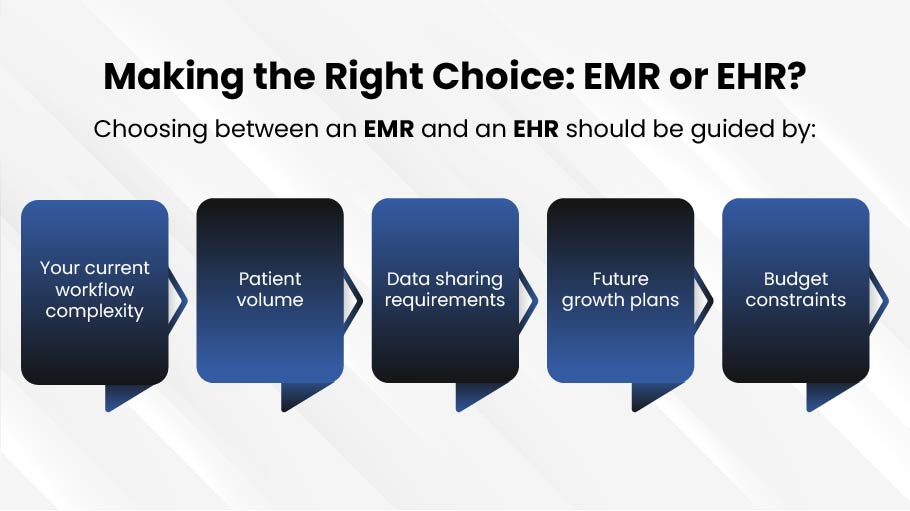
Choosing between an EMR and an EHR should be guided by:
If you’re unsure which route to take, Techmatter Global is here to simplify your decision-making with a free needs assessment.
There is more to the distinction between EMR and EHR than just functionality; it’s a question of perspective. EMRs help you stay in business. You become competitive with EHRs. Investing in a strong, scalable EHR system is the obvious way to go if you want to be at the forefront of patient happiness, operational effectiveness, and regulatory compliance.
And you don’t have to navigate it alone. At Techmatter Global, we’re more than IT consultants; we’re your digital transformation partners.


IT Solutions and Managed Services Provider specializing in developing custom solutions.
 +1 (781) 667-5321
 info@techmatter.co
 100 N Brand Blvd Suite 522, Glendale, CA 91203, USA