In today’s digital age healthcare providers are steadily moving away from paper based systems and embracing the convenience and efficiency of Electronic Health Record (EHRs). These digital records have revolutionized how patient data is stored, accessed and managed across the entire healthcare spectrum. Whether you’re a physician, medical administrator, or a health IT professional, understanding the value of Electronic Health Record Management is crucial in delivering high-quality, coordinated care.
Electronic Health Records (EHRs) explained simply: They are digital versions of a patient’s paper chart. But beyond just a digital chart, EHRs provide a real-time, patient-centered record that makes information available instantly and securely to authorized users.
An electronic health record includes a comprehensive collection of a patient medical history, diagnoses, medications, treatment plans, immunization dates, allergies radiology images & laboratory test results. It also allows providers to automate and streamline their workflow leading to fewer errors and better clinical outcome.
Unlike Electronic Medical Records (EMR) which are limited to the records within one practice, EHR are designed to be shared across very different health care setting ensuring continuity of care.
Electronic Health Record Management is the backbone of modern healthcare IT systems. It involves the organization, storage, retrieval and security of digital patient records. Efficient management ensures that healthcare professionals have accurate and up to date information at their fingertips, improving patient care and safety.
Some key components of successful EHR management include
EHR offer a wide range of advantages over traditional paper records
EHRs allow healthcare providers to access complete & up to date patient information. This supports better decision-making and enables timely treatments. When all health data is available in one place the chances of medical error decrease significantly.
For patients seeing multiple specialists or being transferred between facilities, EHRs ensure seamless communication. This coordination helps in avoiding duplicate tests, unnecessary procedures or conflicting medications.
By reducing paperwork, EHRs streamline operations in clinics and hospitals. Scheduling appointments, billing, documentation and reporting become faster and more efficient.
With patient portals integrated into many EHR systems, patients can access their health records, request refills, view lab results and communicate with the providers. This empower patients to take an active role in their health journey.
In the long term, EHRs reduce costs associated with storage, transcription, chart pulls and administrative labor. They also support preventive care, helping to avoid costly medical interventions later.
While the benefits are clear, implementing EHR systems and ensuring smooth Electronic Health Record Management EHR come with its own set of challenges.
Setting up EHR system requires significant financial investment. This includes software hardware training and often sometimes consulting service.
Healthcare providers and staff may need time and training to adapt to a new digital workflow. Resistance to change & lack of proper training can impact adoption rates.
Since EHRs contain sensitive information, they are prime targets for cyberattacks. Robust cybersecurity measures, such as encryption, multi factor authentication and secure backup systems, must be in place.
Different EHR vendors often use varying data formats or structures, which can hinder smooth information exchange between systems. Efforts toward standardized data exchange protocol ongoing.
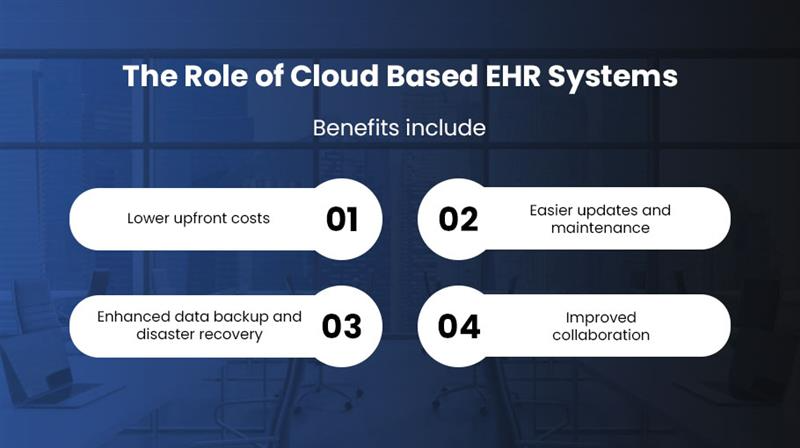
Cloud computing has transformed Electronic Health Record Management by offering scalable, secure & accessible solutions. Cloud based EHRs allow providers to access records from anywhere, using any device with the internet connectivity.
Benefits include
Cloud based systems also simplify regulatory compliance, as vendors often build in security features aligned with industry standard.
The rise of telehealth services has made EHRs even more essential. During virtual consultations, providers rely heavily on digital records to assess patient history and make informed decisions. Integration between telehealth platforms & EHR ensures that data from virtual visits is recorded & accessible like any in person encounter.
As technology evolves so does the role of EHR in shaping healthcare delivery. Some future trends include;
EHR systems are increasingly incorporating artificial intelligence to analyze data and generate predictive insights. This helps identify at risk patients recommend treatments & even flag potential diagnoses.
Blockchain offers enhanced security, transparency and traceability. When combined with Electronic Health Record Management, it could revolutionize how patient data is accessed and shared across the ecosystem.
To improve usability, EHRs are adopting voice enabled data entry and NLP to understand and process physician notes saving time and improving documentation quality.
As genetic data becomes part of the EHR, healthcare providers can offer treatments tailored to an individual’s genetic makeup paving a way for more precise and effective care.
If you want to maximize the effectiveness of EHR system consider these best practices:
Electronic Health Records (EHR) Explained in the simplest terms: they are digital tools that bring efficiency, accuracy and improved outcomes to the healthcare world. With proper Electronic Health Record Management, these systems can dramatically enhance the delivery of care while ensuring compliance and security.
As we move toward a more connected, patient-centric healthcare ecosystem, embracing EHRs is no longer optional it’s essential. The future of healthcare depends on how well we manage, secure and innovate through electronic health records.


IT Solutions and Managed Services Provider specializing in developing custom solutions.
 +1 (781) 667-5321
 info@techmatter.co
 100 N Brand Blvd Suite 522, Glendale, CA 91203, USA