For any healthcare provider, nothing matters more than patient care. But off the record, financial health plays an equally vital role. A practice that struggles to manage payments, claims, and collections risks burnout, cash flow issues, and an inability to grow. This is where Revenue Cycle Management Services become the backbone of operations. And at the heart of effective revenue cycle management lie KPIs, the metrics that show how well your organization is performing.
Consider KPIs as the vital signs of financial health. Just as doctors track blood pressure or heart rate, administrators track revenue metrics to ensure stability. Healthcare organizations can reduce stress, improve efficiency, and continue delivering excellent patient care by focusing on the right numbers and using advanced RCM Solutions.
KPIs: The Health Check for Your Revenue Cycle
Every healthcare practice has a revenue cycle that starts when a patient books an appointment and ends when the payment is fully collected. But without tracking the right KPIs, organizations can’t tell where the leaks or bottlenecks are.
That’s why smart leaders rely on Revenue Cycle Management Services to identify and improve weak spots. Whether it’s claim denials, billing delays, or patient collections, these services provide the expertise and structure to monitor financial health.
Technology is also a huge player here. With Electronic Health Record Management, data flows more smoothly between departments. This ensures billing accuracy, fewer errors, and cleaner claims, all of which directly improve KPIs.
Metrics That Matter Most
Not all KPIs are created equal. Some numbers offer far greater insight into the efficiency of your revenue cycle than others. Here are the essential ones every healthcare organization should track:
- Days in Accounts Receivable (A/R)
This metric tells you how long it takes to get paid after services are provided. If your A/R days are consistently high, it signals bottlenecks in billing, claim submissions, or patient collections. High A/R not only delays cash flow but also increases the risk of non-payment. Healthcare organizations should aim for industry benchmarks (typically under 40 days) and use Revenue Cycle Management Services to streamline billing processes and accelerate reimbursements.
- Clean Claim Rate
A clean claim is one that gets accepted by the payer the first time without needing corrections or resubmissions. The clean claim rate reflects the efficiency and accuracy of your billing process. A high rate reduces administrative workload, prevents payment delays, and directly manages cash flow.
RCM Solutions often include automated coding and error detection tools that catch mistakes before submission, boosting your clean claim percentage and lowering denial risks.
- Denial Rate
Denied claims cost healthcare organizations both time and money. A high denial rate usually points to common issues like inaccurate patient data, coding errors, or eligibility problems. Monitoring denial trends allows you to fix recurring mistakes at the source.
Lowering denial rates requires Electronic Health Record Management integration with billing systems, staff training, and proactive denial management workflows.
- Patient Collection Rate
With patients paying more out-of-pocket due to rising deductibles and co-pays, this KPI is more important than ever. It measures how much revenue you collect directly from patients compared to what is owed.
A low rate could mean weak patient communication or a lack of convenient payment options. To improve this, organizations should offer digital payment portals, text reminders, and flexible payment plans that make it easy for patients to pay on time.
- Net Collection Rate (NCR)
Often called the true measure of collection efficiency, NCR shows how much of the allowable revenue your organization actually collects after adjustments. Anything below industry standards (around 95% or higher) is a warning sign.
Low NCR may indicate issues with payer contracts, billing inefficiencies, or collection policies. Strong RCM Services track this KPI closely to highlight revenue leakage and ensure you’re capturing every dollar you’ve earned.
- First Pass Resolution Rate (FPRR)
This KPI measures how many claims get paid upon first submission without any follow-up. A high FPRR means fewer delays, less rework, and more efficient workflows. It reflects the effectiveness of your coding, documentation, and claim submission process.
Achieving high FPRR often requires advanced RCM Solutions with claim scrubbing tools that detect errors upfront, reducing the back-and-forth with payers.
- Cost to Collect
Revenue growth means little if the cost of collecting it is too high. This metric measures the administrative and operational expenses involved in securing payments. High costs may result from too much manual work, excessive re-submissions, or outdated billing processes. Organizations can reduce collection costs and increase overall profitability by involving automation, analytics, and EHR-integrated workflows.
Organizations can create a clear roadmap for improving financial outcomes by monitoring these KPIs regularly.
How Technology Enhances KPI Tracking
The role of technology in Revenue Cycle Management Services cannot be overstated. From automated claim scrubbing to predictive analytics, advanced tools make it easier to track KPIs and act on them. Electronic Health Record Management also plays a huge role by ensuring accurate data capture at the very start of the cycle, which reduces errors downstream.
Modern RCM Solutions integrate financial and clinical data, providing real-time dashboards that give administrators a clear view of performance. This allows for quicker decisions and proactive management of potential issues before they become revenue leaks.
Common Challenges in Monitoring KPIs
Monitoring KPIs does not come without challenges. Data silos, lack of staff training, and outdated technology can all make it difficult to track the right metrics. Some organizations struggle to standardize their reporting, which leads to inconsistent insights.
Partnering with professional Revenue Cycle Management Services can help overcome these barriers by providing both the expertise and the tools needed to monitor KPIs effectively.
FAQs
- What are RCM KPIs in healthcare?
They are key metrics that track the financial performance of the revenue cycle.
- Why are RCM KPIs important for providers?
They help minimize denials, increase the payments, and improve cash flow.
- How do RCM Solutions improve KPI performance?
They automate billing, reduce errors, and provide real-time insights.
- What role does Electronic Health Record Management play in RCM?
It ensures accurate data and coding, which leads to faster reimbursements.
- How can healthcare organizations start tracking KPIs?
By setting benchmarks, using RCM Solutions, and partnering with experts.
Conclusion
The success of any healthcare organization depends on how well it balances patient care with financial sustainability. KPIs act as the bridge between these two priorities. Healthcare providers gain a clear picture of where improvements are needed by having a closer look at these KPIs.
Investing in modern RCM Solutions and using Electronic Health Record Management ensures that KPIs are not just numbers on a dashboard, but actionable initiatives that drive growth. Ultimately, strong KPI management transforms revenue cycle operations into a strategic advantage, allowing healthcare organizations to work in today’s competitive environment.
Maintaining a healthcare organization’s financial stability is just as important as delivering high-quality care, and that’s where Revenue Cycle Management (RCM) comes in. With efficient RCM services and accurate health record management, organizations can reduce errors, minimize delays, and make sure they receive timely, accurate payment for the care they provide. A strong RCM system helps make sure healthcare organizations get paid correctly and on time, keeps administrative headaches to a minimum, and improves overall patient satisfaction.
Yet, despite its importance, many organizations still face struggles like inefficiencies, delayed reimbursements, and claim denials. The good news? There are practical, actionable steps healthcare organizations can take to improve Revenue Cycle Management and strengthen their financial stability.
What is Revenue Cycle Management Exactly?
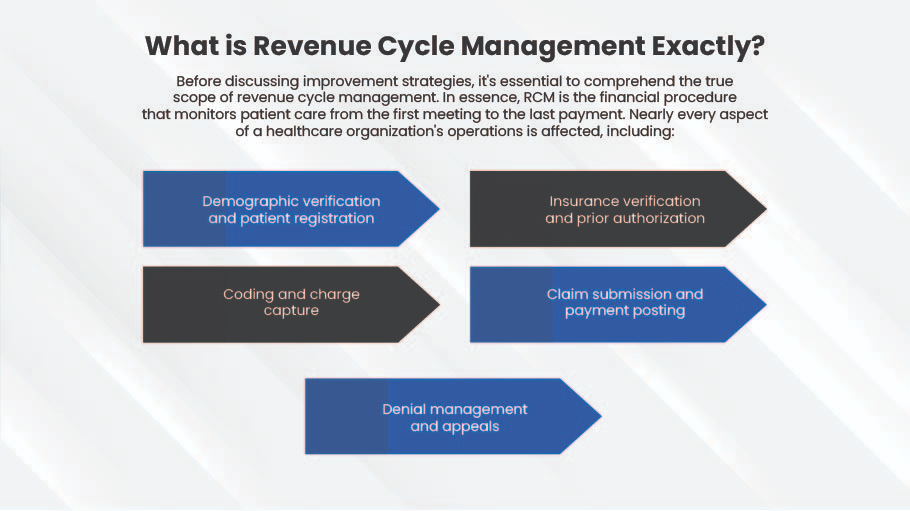
Before discussing improvement strategies, it’s essential to comprehend the true scope of revenue cycle management. In essence, RCM is the financial procedure that monitors patient care from the first meeting to the last payment. Nearly every aspect of a healthcare organization’s operations is affected, including:
- Demographic verification and patient registration
- Insurance verification and prior authorization
- Coding and charge capture
- Claim submission and payment posting
- Denial management and appeals
When executed correctly, RCM ensures providers receive timely and accurate reimbursement for their services. Conversely, gaps in any step can lead to delayed payments, higher administrative costs, and even negative patient experiences.
Maximizing Efficiency with Revenue Cycle Management
Many healthcare setups choose to outsource or enhance their in-house processes with professional Revenue Cycle Management Services. These services bring knowledge, automation, and compliance knowledge that can make a huge difference.
Here’s why partnering with Revenue Cycle Management Services can improve your organization’s bottom line:
- Expertise: Trained professionals who know billing, coding, and healthcare regulations inside out.
- Efficiency: Automated systems that reduce manual errors and speed up claim submission.
- Compliance: Assurance that billing processes meet current federal and payer regulations.
- Cost Savings: Reduced overhead from fewer errors, quicker reimbursements, and lower administrative workload.
Whether handled in-house or outsourced, the goal is the same: a smoother, faster, and more reliable revenue cycle.
Making RCM Work Better with Health Record Management
Effective Health Record Management is the cornerstone of successful Revenue Cycle Management. If patient facts are incorrect or incomplete, claims are likely to be denied, delayed, or underpaid.
A strong Health Record Management system facilitates numerous ways:
- Keeps affected person demographics and insurance facts correct
- Links clinical methods to proper codes for billing
- Reduces duplication and information gaps
- Enhances communication between the scientific and billing bodies of workers
Linking Electronic Health Records (EHR) with Revenue Cycle Management Services enables groups to keep patient records accurate, speed up billing, reduce claim denials, and receive payments in a timely manner.
Key Strategies for Improving Revenue Cycle Management
Improving RCM doesn’t have to be overwhelming. Here are some practical strategies that can make a significant difference:
- Verify Insurance Coverage Upfront
One of the reasons claims are denied or delayed is insurance issues. Verifying insurance coverage before treatments can help patients understand their financial obligations, save time, and avoid mistakes.
Here’s what verifying insurance includes:
- Confirming active coverage
- Checking copays, deductibles, and co-insurance
- Identifying prior authorization requirements
Many Revenue Cycle Management Services offer tools for real-time eligibility verification, making this process efficient and accurate.
- Focus on Accurate Medical Coding
Medical coding is the bridge between clinical services and reimbursement. Even minor mistakes can result in denials or underpayment. To improve coding accuracy:
- Train staff regularly or hire certified coders
- Stay updated with ICD-10, CPT, and HCPCS codes
- Implement coding software to reduce human error
Correct coding improves first-pass claim acceptance rates and ensures compliance with payer rules.
- Communicate Clearly With Patients
Today’s patients have greater financial obligations because of high-deductible plans. Clear billing communication improves collections and lessens confusion. Here’s what clear communication should include:
- Providing procedure estimations up front
- Making appropriate payment arrangements
- Reminding people by mail, SMS, or email
Improved communication reduces the likelihood of outstanding balances and improves patient satisfaction.
- Track and Manage Claim Denials
Denials are unavoidable, but how an organization responds makes all the difference. Proactively managing denials includes:
- Identifying common denial reasons
- Correcting errors and resubmitting claims quickly
- Implementing preventive measures to avoid repeat issues
Many Revenue Cycle Management Services include analytics to monitor denials and optimize processes.
- Optimize Health Record Management Systems
A well-integrated Health Record Management system ensures a smooth flow of accurate patient information between departments. Benefits include:
- Eliminating duplicate entries
- Improving documentation for billing
- Providing real-time access to patient and billing information
Training staff to use these systems efficiently enhances overall Revenue Cycle Management.
- Automate Repetitive Tasks
Automation is a game-changer in modern RCM. Common automation areas include:
- Claim scrubbing to detect errors before submission
- Payment posting
- Electronic Remittance Advice (ERA) processing
Automating repetitive tasks reduces errors, saves staff time, and accelerates revenue collection.
- Monitor Key Performance Indicators (KPIs)
Monitoring KPIs on a daily basis enables practices to point out issues and assess their progress.
Here are a few key RCM KPIs:
- Accounts Receivable (A/R)
- Acceptance rate of new claims
- Denial rates
- Net collection rate
Keeping in mind these crucial metrics, businesses can continuously improve and modify their revenue cycle management processes.
Benefits of Strong Revenue Cycle Management
Effective Revenue Cycle Management isn’t just about collecting payments quickly; it’s about creating a system that keeps the entire organization running smoothly. When done right, it strengthens financial health, lightens the load on staff, and builds trust with patients.
With streamlined processes, providers benefit from:
- Steady cash flow and greater financial security
- Less administrative pressure on teams
- A positive patient experience through fair, transparent billing
- Confidence in meeting all payer and regulatory standards
In short, strong Revenue Cycle Management lays the groundwork for growth, efficiency, and lasting success in healthcare operations.
Bottom Line
Improving Revenue Cycle Management doesn’t have to be complicated. With the right Revenue Cycle Management Services and accurate Health Record Management, organizations can simplify billing, cut down errors, and run more efficiently. Focusing on insurance verification, correct coding, automation, and monitoring key metrics allows providers to maximize revenue, avoid denials, and keep patient care front and center.
Let’s face it, healthcare isn’t just about caring for patients. It’s also about keeping the business running. That’s where Revenue Cycle Management (RCM) comes into play. For practices of all sizes, especially in a competitive and regulation-heavy market like the U.S., RCM isn’t optional; it’s essential.
Whether you are operating a multi-location healthcare company or a tiny clinic, knowing and improving your RCM process might be the difference between a successful business and one that barely makes ends meet. You’re at the proper position if you want to increase profitability, decrease claim denials, or get more control over your billing procedure.
Understanding the Core of RCM
Revenue cycle management is the act of monitoring and controlling all clinical and administrative tasks related to processing claims, making payments, and generating income. From the moment a patient schedules an appointment to when the final payment is collected, RCM touches every stage.
But here’s where it gets even more valuable: Effective Revenue Cycle Management Solutions don’t just handle billing. They reduce errors, speed up payments, and ultimately increase the bottom line.
Why RCM Is More Than Just Billing
Many confuse RCM with billing. While billing is a piece of the puzzle, RCM is the full framework.
Picture it like this: Billing is the engine, but RCM is the whole car, including the wheels, steering, and GPS.
Medical Billing Services typically focus on submitting claims and processing payments. RCM, however, goes deeper. It involves verifying insurance, checking for authorization requirements, coding diagnoses using ICD Codes In RCM, scrubbing claims for errors, appealing denials, collecting from patients, and providing detailed reporting.
So if you’re just “billing,” you’re leaving money and efficiency on the table.
The Real Steps in RCM That Make or Break a Practice
Let’s break it down into steps:
1. Patient Access Management
Everything starts here. This includes appointment scheduling, collecting demographics, and verifying insurance. If done wrong, the rest of the revenue cycle is built on shaky ground.
Pro tip: Real-time eligibility checks cut down on rejected claims later.
2. Insurance Verification & Authorization
Is the patient covered? Is pre-auth required? Failure to answer these upfront can mean immediate revenue loss. Techmatter Global recommends automating this step for better results, as it’s where delays often originate.
3. Documentation and Charge Capture
Providers must document care accurately and consistently. Missed services = missed revenue. Using smart EHRs integrated with your Revenue Cycle Management Solutions ensures nothing gets lost between care and billing.
4. Medical Coding
This is where ICD Codes in RCM come in. The patient’s diagnosis and treatments are represented by these standardized codes, which guarantee that insurance companies know what was done and why it should be reimbursed.
Errors in coding are one of the top reasons for denials. That’s why trained medical coders and coding audits are critical.
5. Claims Submission
The likelihood of a clean claim being paid on the first attempt is the highest. Claim cleansing software comes in handy in this situation. Before submission, it looks for compliance issues, mismatched codes, and missing information.
One missed modifier or a wrong ICD code? That’s a denial.
6. Denial Management & Appeals
Not every claim gets paid the first time. But that doesn’t mean it’s a loss. Denied claims should be tracked, corrected, and appealed quickly.
A responsive denial management strategy is a hallmark of top-performing Medical Billing Services. Techmatter Global’s RCM experts prioritize reworking denials with fast turnaround and high resubmission success rates.
7. Payment Posting
Accurate and timely posting of insurance and patient payments is required. This phase helps find underpayments, duplication, or write-offs and guarantees that accounts are current. Automated posting tools speed up this process, reduce errors, and improve cash flow visibility.
8. Patient Billing & Collections
Many patients are now responsible for a larger portion of their healthcare costs. That means clear, understandable billing is a must. Want fewer overdue balances? Make it easy to pay through online portals, SMS reminders, and card-on-file options.
9. Reporting & Analytics
You can’t improve what you don’t measure.
A strong Revenue Cycle Management Solution should give you access to reports on claim aging, denial rates, collection percentages, and more.
And if you’re partnering with an external vendor, like a Medical Billing Services provider, you should expect complete transparency and monthly performance reviews.
Why Techmatter Global Focuses on RCM Excellence
At Techmatter Global, we don’t just view RCM as a back-end function; we see it as a growth engine. Our team integrates Revenue Cycle Management Solutions into your existing workflows or builds custom ones to scale with you.
We understand the challenges providers face: staff shortages, rising patient deductibles, increased claim rejections, and stricter compliance rules. That’s why we take a hands-on approach.
From implementing clean coding protocols (yes, including compliant ICD Codes In RCM) to building denial dashboards and predictive analytics, our RCM model is built for performance.
The Lead-Generating Power of RCM
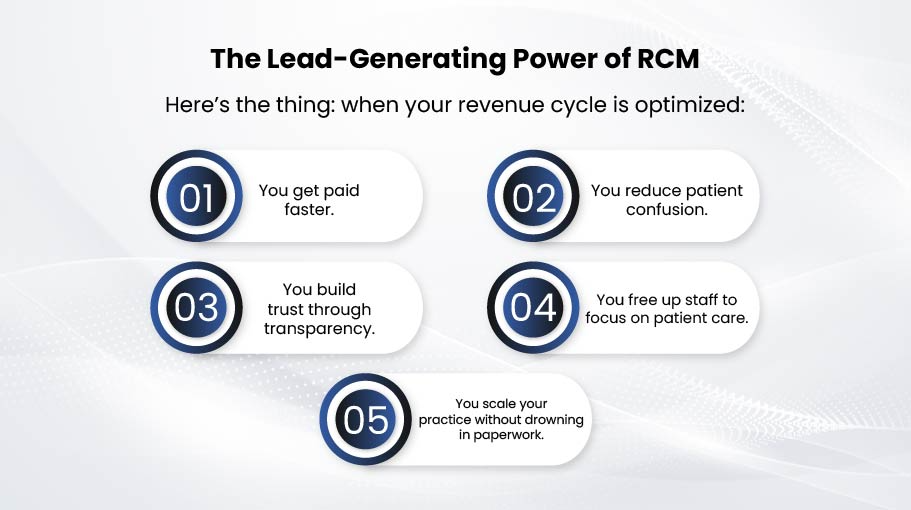
Here’s the thing: when your revenue cycle is optimized:
- You get paid faster.
- You reduce patient confusion.
- You build trust through transparency.
- You free up staff to focus on patient care.
- You scale your practice without drowning in paperwork.
That’s exactly what your future clients (or partners) want to hear. And that’s what sets your practice apart from the rest.
Time to Rethink Your RCM Strategy
Still relying on outdated billing systems or fragmented software? Or maybe your front-desk team is stretched too thin to keep up with eligibility checks and billing follow-ups?
Now is the time to reassess. Whether you need a full-service Medical Billing Services provider or want to upgrade your internal workflows with robust Revenue Cycle Management Solutions, the ROI is worth it.
Let Techmatter Global show you how optimized RCM can turn financial chaos into clarity. Our deep expertise in ICD Codes in RCM, claim lifecycle management, and patient billing strategy means you’re not just surviving, you’re scaling with confidence.
TechMatter has officially welcomed DoctorPapers to its growing portfolio in a strategic move aimed at scaling and enriching its Revenue Cycle Management Services. This milestone isn’t just a corporate acquisition; it’s a step toward reshaping how healthcare providers handle billing, operations, and compliance through smarter, more agile RCM solutions.
In a health care industry where every dollar counts and delays represent risks to patient care, this partnership is just what the industry requires. The partnership brings together TechMatter’s robust automation and digital capability with DoctorPapers’ hands-on RCM experience providing a comprehensive and future-facing solution to providers.
Why This Acquisition Matters to Healthcare Providers
For practices struggling with delayed reimbursements, claim denials, and compliance gaps, the traditional RCM approach often falls short. Many providers, especially small to midsize clinics, are buried in administrative overwhelm. What TechMatter and DoctorPapers now offer together is a lifeline, an ecosystem of integrated RCM services backed by Digital Health innovations that streamline processes and improve financial outcomes.
DoctorPapers brings a proven track record, having served over 500 provider practices across specialties. Their strength is in providing specialized solutions that truly meet the individual needs of each practitioner, whether it be in urgent care or behavioral health. The outcome is a potent tool for healthcare providers trying to reduce expenses, increase collections, and maintain compliance when paired with TechMatter’s scalable infrastructure and automation capabilities.
A Strategic Fit for Long-Term Value
TechMatter didn’t just acquire a billing company; it gained a team of seasoned professionals, time-tested systems, and a loyal customer base. This move aligns with TechMatter’s core mission: to deliver RCM solutions that are as efficient as they are intelligent.
The acquisition allows for:
- Enhanced coding accuracy and denial prevention
- Faster credentialing and provider onboarding
- Deeper EHR integration for seamless workflows
- Scalable staffing and virtual support models
This isn’t about adding more services. It’s about making RCM frictionless, so providers can focus on delivering care, not chasing payments.
Driving Growth Through Automation and Human Expertise
This partnership’s equilibrium is what makes it so lovely. DoctorPapers relies on practical execution and customer service, whereas TechMatter is recognized for automation, analytics, and next-generation technology. Unmatched value is produced for medical practices by combining intelligent software with knowledgeable human resources.
Together, the new TechMatter-DoctorPapers alliance empowers clinics to:
- Submit cleaner claims
- Reduce payment cycle times.
- Improve staff productivity
- Monitor RCM performance in real-time.
As healthcare becomes more data-driven, having a tech-enabled RCM partner is no longer optional; it’s mission-critical. This partnership delivers exactly that.
A Win for Underserved and Growing Practices
One of the biggest wins from this onboarding is for small to mid-size practices that often get left behind in the world of large enterprise healthcare. DoctorPapers already has a foothold in underserved markets, and with TechMatter’s infrastructure, those providers now get access to enterprise-grade tools without enterprise-level headaches.
These clinics can now:
- Leverage digital dashboards to track claims
- Outsource key RCM tasks while maintaining control.
- Access on-demand support and consulting
- Prepare for value-based care transitions confidently.
It’s not just RCM. It’s RCM made scalable, accessible, and ready for the future.
Leadership That Gets It
TechMatter CEO Mubashir Hanif said it best:
“We are thrilled to welcome DoctorPapers into the TechMatter family. By uniting our platforms, expertise, and shared vision, we’ll deliver even greater value to healthcare providers across the country.”
DoctorPapers’ leadership team remains intact, ensuring continuity for their clients. The merger was intended to be seamless, completely enhanced, and disrupt-free. With the addition of resources and technology to improve their operations, clients still collaborate with the same individuals they trust.
Looking Ahead: A Stronger RCM Ecosystem
This onboarding isn’t a finish line—it’s a starting point. In the coming months, TechMatter plans to roll out:
- Advanced reporting and analytics tools
- AI-powered coding audits
- Custom credentialing dashboards
- Integrated Digital Health support tools
The goal? To redefine what modern Revenue Cycle Management Services look like. It’s about creating a seamless experience where software, service, and support work as one.
Your Practice Deserves More Than Just Billing Help
If your clinic is tired of the same billing errors, denials, or slow cash flow, it’s time to explore something better. TechMatter and DoctorPapers now offer that “better” full-stack RCM solution grounded in innovation, delivered by people who understand the business of healthcare.
This alliance offers you the opportunity to enter the future of billing, regardless of whether you are a multispecialty group or a single provider. Avoid using antiquated RCM models. One claim at a time, let TechMatter demonstrate how more intelligent RCM may revolutionize your practice’s operations.
Ready to elevate your revenue cycle? Talk to TechMatter today..
Imagine this: a patient walks into your clinic, receives quality care, and walks out satisfied but your practice doesn’t get paid correctly or on time. Sound familiar? This is where Revenue Cycle Management (RCM) comes into play. At its core, RCM is the systematic process that healthcare organizations use to track patient care episodes from registration and appointment scheduling to the final payment of a balance. But in today’s competitive and compliance-heavy landscape, RCM is far more than just billing it’s the heartbeat of a financially healthy practice.
For providers looking to eliminate inefficiencies, improve collections and enhance patient satisfaction, RCM is not an option it is a necessity. And if you want to implement best practices? Companies like Techmatter Global are changing the way providers source revenue cycle management services with smart, customized solutions.
Why RCM Is More Than Just a Back-End Function
RCM often happens behind the scenes, but its impact is front and center. When done right, it ensures timely reimbursements, minimizes denials and creates a smooth financial experience for patients. But when it’s neglected? You see delays, errors, compliance issues and revenue leakage that can quietly erode your bottom line.
Modern RCM is about so much more than sending claims and waiting for checks. It’s about:
- Optimizing every touchpoint, from scheduling to collections
- Leveraging data and automation to reduce errors and manual tasks
- Improving transparency and communication for patients
- Ensuring compliance with changing payer rules and government regulations
This is where expert revenue cycle management services shine.
From Appointment to Payment: The Full RCM Journey
The RCM process starts the moment a patient books an appointment and doesn’t end until every dollar is accounted for. Let’s break it down:
1. Patient Access and Pre-Verification
It all begins with data accurate demographics, insurance verification and eligibility checks. This step is often overlooked but critical. Errors here cascade into denied claims and billing delays.
2. Charge Capture and Clinical Documentation
Every service provided must be accurately documented. This clinical data forms the basis of the bill. If it’s incomplete or inconsistent, you’ll face delays, denials or underpayments.
3. Medical Coding and Billing
Here’s where billing and coding services come in. Certified coders apply appropriate CPT and ICD codes to services rendered. Precision in coding isn’t just about accuracy it directly affects your reimbursement rate.
Partnering with an experienced team like Techmatter Global ensures compliance and efficiency in coding, which improves your bottom line while reducing audit risk.
4. Claim Submission and Tracking
Clean claims get paid faster. Modern RCM services use tools that validate claims before submission, reducing denials significantly.
5. Payment Posting and Reconciliation
Payments are posted, discrepancies are flagged, and adjustments are made. Speed and accuracy are essential to avoid overpayments or lost revenue.
6. Denial Management and Appeals
Even clean claims can be denied. RCM professionals track reasons, resubmit corrected claims, and analyze trends to prevent future issues.
7. Patient Collections and Follow-Up
Patients are responsible for a growing share of healthcare costs. Offering clear statements, online portals, and flexible payment options increases collection rates and patient satisfaction.
Why In-House Isn’t Always Enough
Many providers try to manage RCM in-house. But with constant changes in coding rules, payer requirements, and healthcare regulations not to mention staffing challenges it’s easy to fall behind.
That’s why outsourcing to a company like Techmatter Global makes sense. Our revenue cycle management services don’t just plug gaps we proactively optimize each phase of the cycle, using a combination of expert talent and intelligent automation. You get:
- Fewer denials
- Faster reimbursements
- Lower administrative overhead
- Better data visibility and reporting
- Peace of mind
The Role of Billing and Coding Services in Maximizing Revenue
Did you know that improper coding is one of the leading causes of lost revenue? In fact, it’s not uncommon for practices to under-code out of fear of audits or to over-code and face penalties.
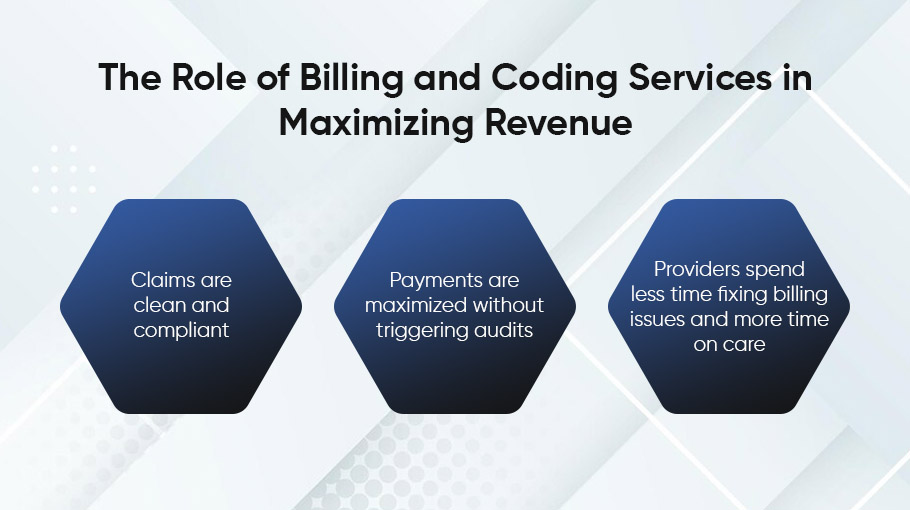
At Techmatter Global, we take a precise and compliant approach to billing and coding services. Our coders are certified, trained across specialties, and updated regularly on coding changes. This ensures:
- Claims are clean and compliant
- Payments are maximized without triggering audits
- Providers spend less time fixing billing issues and more time on care
When billing and coding are done right, everything else flows smoother literally and financially.
Tech and Trends That Are Reshaping RCM
Modern revenue cycle management services aren’t just about manpower they’re about smart technology. Automation, AI, and real time analytics are changing the traditions.
1. Automation
Tasks like insurance eligibility, claim scrubbing, and payment reminders can all be automated. This means fewer mistakes and faster processing.
2. Real Time Reporting
Dashboards let providers see trends and act fast before issues snowball into revenue leaks.
3. Integration with EHRs and Patient Portals
A seamless experience for both staff and patients improves engagement and financial transparency.
At Techmatter Global, we don’t just follow these trends we lead with them.
How Techmatter Global Helps Providers Like You
We’re not just another RCM vendor we’re your strategic partner in financial health.
Whether you’re a solo practitioner, specialty clinic, or midsize hospital, we tailor our revenue cycle management services to fit your needs and budget.
Our team works closely with yours to:
- Analyze your current processes
- Identify inefficiencies and leakage points
- Streamline workflows
- Implement smart tools that cut costs and boost collections
And we don’t disappear after onboarding. We stay with you, providing transparent reports, ongoing optimization and proactive support every step of the way.
Conclusion: It’s Time to Rethink RCM
RCM isn’t just a function it’s your practice’s financial engine. And in today’s healthcare world, you can not afford to leave it to chance. If you’re struggling with rising denials, slow payments, or a billing team stretched too thin, it’s time to rethink your strategy.
At Techmatter Global, we help providers like you unlock the full value of modern revenue cycle management services and billing and coding services so you can focus on what you do best: delivering exceptional care.
Let’s talk about how we can help your organization grow and thrive one clean claim at a time.
- Introduction
- What is Revenue Cycle Automation?
- Key Components
- Streamlined Billing Processes
- Enhanced Patient Experience
- Increased Financial Performance
- Compliance and Security
- Operational Efficiency
- Improved Accuracy in Claims Processing
- Data-Driven Decision Making
- Scalability and Flexibility
- Patient Satisfaction and Loyalty
- Case Studies and Real-World Examples
- Challenges and Considerations
- Conclusion
- FAQs
Introduction
Revenue Cycle Management (RCM) is the foundation of financial health in medical care organizations. It includes all regulatory and clinical capabilities that add to catching, making due, and gathering patient assistance income. With the rising intricacy of healthcare billing and the interest in working on persistent encounters, income cycle robotization has arisen as a unique advantage. However, what precisely is income cycle robotization, and for what reason is it so valuable?
Learn more about Steps in Revenue Cycle Management (RCM)
What is Revenue Cycle Automation?
Revenue cycle automation insinuates using advanced programming deals with robotize different pay cycle parts, from patient enlistment and charging to portion collection and data examination. This advancement utilizes man-made awareness (reenacted insight) and artificial intelligence (ML) to streamline processes, reduce manual mix-ups, and further develop capability.
Key Components
- Automated Billing Systems: Programming that mechanizes the charging system, lessening the manual information section.
- Electronic Health Records (EHR) Integration: Consistent combination with EHR frameworks for exact and exceptional patient data.
- Claims Management: Automation of claims submission, tracking, and resolution.
Streamlined Billing Processes
One of the most quick advantages of income cycle robotization is the smoothing out of charging processes. Manual charging is inclined to blunders, which can prompt postponements and lost income.
- Reduction of Manual Errors
Mechanization essentially diminishes the gamble of human blunder by guaranteeing that information is precisely caught and handled. This prompts fewer case dismissals and dissents.
- Faster Billing Cycles
With automated systems, billing cycles are expedited. Claims are submitted quicker, and payments are received faster, improving cash flow.
Enhanced Patient Experience
Revenue cycle automation doesn’t just benefit the healthcare provider; it also enhances the patient experience.
- Improved Patient Communication
Automated systems provide patients with timely and accurate information about their bills and payments. This transparency builds trust and reduces confusion.
- Transparency in Billing
Patients can easily access their billing information online, which simplifies the process and makes it easier for them to understand and manage their healthcare expenses.
Increased Financial Performance
Automation can have a substantial positive impact on a healthcare provider’s financial performance.
- Improved Cash Flow
By accelerating the billing cycle and diminishing mistakes, revenue cycle automation keeps a consistent income. This is basic for the financial stability of any medical care supplier.
- Reduced Operational Costs
Automating repetitive tasks decreases the requirement for broad physical labor, prompting lower functional expenses. Staff can zero in on additional essential exercises that enhance the association.
Compliance and Security
Healthcare providers must adhere to strict regulatory standards, and revenue cycle automation can help ensure compliance while enhancing data security.
- Adherence to Regulatory Standards
Automated systems are regularly updated to comply with the latest regulations, reducing the risk of non-compliance and associated penalties.
- Enhanced Data Security
With cutting-edge security highlights, automated frameworks safeguard delicate patient data from breaks and unapproved access.
Operational Efficiency
Automation upgrades, by and large functional effectiveness via automating repetitive tasks and guaranteeing consistent joining with existing frameworks.
- Automation of Repetitive Tasks
Tasks, such as information passage, arrangement booking, and billing, can be automated, opening up staff to zero in on additional complicated liabilities.
- Integration with Existing Systems
Automated solutions can be integrated with current EHR and practice management systems, ensuring smooth operation and data consistency.
Improved Accuracy in Claims Processing
Accurate claims processing is crucial for revenue generation, and automation plays a pivotal role in this area.
- Reduction in Claim Denials
Automated systems accurately capture and verify information, leading to fewer claim denials and increased revenue.
- Faster Claim Resolution
Automation speeds up the goal of denied claims by distinguishing and rectifying mistakes rapidly, guaranteeing that cases are handled sooner rather than later.
Data-Driven Decision Making
Revenue cycle automation gives admittance to ongoing examination, empowering better independent direction.
- Real-Time Analytics
Providers can access cutting-edge financial information and execution measurements, taking into account informed choices and vital preparation.
- Better Financial Forecasting
With detailed investigation, medical services suppliers can figure out future financial performance all the more precisely, assisting with arranging and designate assets effectively.
Scalability and Flexibility
Automated revenue cycle management systems are scalable and flexible, catering to the evolving needs of healthcare providers.
- Adaptability to Changing Needs
As healthcare practices grow and change, automated systems can easily adapt to new requirements without significant disruptions.
- Support for Growing Practices
Automation supports the expansion of healthcare practices by ensuring that revenue cycle processes can handle increased patient volumes and complexities.
Patient Satisfaction and Loyalty
A seamless and transparent billing process can significantly enhance patient satisfaction and loyalty.
- Simplified Payment Processes
Patients appreciate the ease of automated billing and payment options, leading to higher satisfaction and loyalty.
- Enhanced Overall Patient Experience
By reducing billing-related stress and confusion, automation contributes to a more positive overall patient experience.
Case Studies and Real-World Examples
Several healthcare providers have successfully implemented revenue cycle automation, yielding significant benefits.
- Success Stories
Examples of healthcare institutions that have seen improved financial performance and patient satisfaction through automation.
- Lessons Learned
Insights and best practices from organizations that have implemented revenue cycle automation.
Challenges and Considerations
While the benefits are substantial, there are challenges to consider when implementing revenue cycle automation.
- Potential Implementation Challenges
Possible obstacles include integration issues, staff resistance, and the initial investment cost.
- Mitigation Strategies
Strategies to overcome challenges include thorough planning, training programs, and selecting the right technology partner.
Conclusion
Revenue cycle automation is changing the medical services industry by working on financial performance, upgrading patient encounters, and guaranteeing compliance. As innovation keeps on developing, the advantages of mechanization will just develop, making it a fundamental speculation for medical care suppliers planning to flourish in an undeniably complicated climate.
FAQs
- What is revenue cycle automation?
Income cycle robotization utilizes progressed programming answers to mechanize different parts of the income cycle, including charging, claims handling, and installment assortment.
- How does revenue cycle automation improve patient experience?
It upgrades patient correspondence, gives straightforwardness in charging, and improves installment processes, prompting higher fulfillment and devotion.
- What are the cost benefits of revenue cycle automation?
Computerization lessens functional expenses by limiting difficult work and blunders, prompting further developed income and monetary strength.
- Are there any risks associated with revenue cycle automation?
Potential dangers incorporate coordination challenges, introductory expenses, and staff obstruction, yet these can be relieved with legitimate preparation and preparation.
- How can healthcare providers get started with revenue cycle automation?
Suppliers ought to begin by assessing their ongoing cycles, choosing the right innovation accomplice, and carrying out a staged way to deal with coordinate robotization arrangements.
In perplexing medical care and administration enterprises, productively overseeing income is fundamental for supporting tasks and guaranteeing monetary security. Income Cycle The executives (RCM) is at the core of this work, enveloping a progression of fundamental revenue generation and cash flow cycles. This inside-and-out guide unloads the complexities of RCM methodology, featuring essential parts, difficulties, and best practices to assist organizations with dominating income across the board.
The Revenue Cycle: Key Stages and Significance
The income cycle is a web of interconnected stages, each assuming a fundamental part in the consistent progression of monetary exchanges inside an association. From patient enlistment and protection checks to charge catch, claims accommodation, installment posting, repudiation of the board, and patient assortments, each step is a piece of the riddle in upgrading revenue enhancement and functional proficiency.
Critical Strategies for Healthcare Success in Revenue Cycle Management (RCM)

Revenue Cycle Management (RCM) is the backbone of financial health for healthcare organizations. It encompasses the entire process of managing the economic aspects of patient care, from the initial appointment scheduling and patient registration to the final medical bill payment. Effective RCM ensures that healthcare providers are paid promptly and accurately, which in turn enables them to continue delivering high-quality care.
Here are vital strategies for achieving success in RCM:
- Patient Registration and Eligibility Verification
One of the initial steps in RCM is patient registration, which includes collecting accurate demographic and insurance information. Errors or omissions during this phase can lead to claim denials or delays. Implementing an automated system for patient registration can minimize human error.
Additionally, verifying patient insurance eligibility before services are rendered ensures the provider will be reimbursed for their services. Automated eligibility verification tools can check coverage in real-time, reducing the risk of claim denials due to ineligible coverage.
- Invest in Advanced Technology and Automation
Automation is changing RCM by lessening manual cycles and improving precision. Mechanical Cycle Mechanization (RPA) can handle redundant errands like information passage, guarantee accommodation, and installment posting.
Machine Learning (ML) and AI calculations can anticipate and distinguish designs in denied claims, considering proactive measures to be taken. Progressed examination instruments give bits of knowledge into income cycle execution, recognizing bottlenecks and improvement regions. Putting resources into a decisive RCM programming stage incorporating Electronic Wellbeing Records (EHR) can fundamentally smooth the income cycle.
- Improve Coding and Documentation Practices
Precise clinical coding and exhaustive documentation are critical for the progress of RCM. Coding blunders can prompt claim denials, deferrals, and likely legitimate issues. Customary preparation and certification for coding staff are fundamental to remaining refreshed with the most recent coding principles and guidelines.
Carrying out Clinical Documentation Improvement (CDI) projects can upgrade the nature of clinical documentation, guaranteeing that all administrations given are precisely caught and coded. This supports precise charging and further develops patient consideration quality.
- Enhance Patient Financial Communication and Engagement
Transparent and strong correspondence with patients regarding their monetary obligations can help them understand their experience and decrease the probability of terrible obligations. Furnishing patients with precise, concise data about their protection inclusion, co-pays, deductibles, and personal costs oversees assumptions and encourages trust. Offering various installment choices, including on-the-web installment entries, installment plans, and monetary help programs, can make it more straightforward for patients to settle their bills.
Proactive correspondence, like sending updates about forthcoming installments, can assist with decreasing missed installments.
- Optimize Claims Management and Denial Resolution
The executive’s interaction is fundamental to RCM’s prosperity in these cases. Guaranteeing that cases are precisely finished and submitted quickly is basic. A computerized claims-the-board framework can smooth out this cycle, lessening blunders and accelerating accommodation times.
Despite best endeavors, guarantee disavowals are unavoidable. In this manner, having a devoted group to deal with disavowals and requests is fundamental. This group should dissect refusal patterns, recognize underlying drivers, and conduct remedial activities to forestall future dissents. Routinely checking on and examining claims cycles can assist with keeping up with high precision and effectiveness standards.
- Data Analytics and Reporting
Data analytics is a powerful tool for improving RCM. By analyzing data from various points in the revenue cycle, healthcare organizations can gain insights into performance metrics such as claim acceptance rates, denial rates, days in accounts receivable (A/R), and cash flow trends.
Dashboards and real-time reporting tools visually represent key performance indicators (KPIs), making it easier to identify areas that require attention. Predictive analytics can forecast future trends and potential issues, allowing for proactive management and decision-making.
- Ensure Regulatory Compliance
The healthcare industry is heavily regulated, with strict guidelines governing billing and reimbursement. Ensuring compliance with regulations such as the Health Insurance Portability and Accountability Act (HIPAA), the Affordable Care Act (ACA), and various payer-specific rules is crucial to avoid penalties and legal issues.
Regular compliance training for staff, conducting internal audits, and staying updated with regulatory changes are essential practices. A compliance management system can help monitor and enforce adherence to regulatory requirements.
- Foster Collaboration Between Departments
Fruitful RCM requires a coordinated effort between clinical, regulatory, and monetary groups. Separating storehouses and advancing correspondence and collaboration can prompt more effective cycles and improved results. Everyday gatherings and cross-functional instructional meetings assist with guaranteeing all colleagues comprehend their jobs and how they add to the general income cycle. Coordinated effort apparatuses and stages can work with correspondence and data sharing across divisions.
- Implement Patient Financial Assistance Programs
Giving monetary help to patients who can’t afford their medical expenses isn’t just a merciful practice but also an essential one. It can work on persistent fulfillment and unwaveringness while paying off awful obligations.
Creating and advancing a far-reaching monetary help program, including noble cause care strategies and sliding scale installment choices, can assist patients in exploring their financial obligations. Instructing patients about these projects and helping them with the application interaction can also improve these drives’ viability.
- Constantly Monitor and Improve Processes
RCM is not a one-time exertion but a continuous interaction requiring ceaseless checking and improvement. Routinely inspecting and refreshing strategies and methodology, directing execution evaluations, and looking for input from staff and patients can assist with recognizing regions for development.
Executing a culture of consistent improvement, where staff are urged to recommend and carry out process upgrades, can prompt supported progress in RCM. Embracing a proactive way to deal with critical thinking and remaining in front of industry patterns and mechanical progressions can keep medical care associations competitive and financially healthy.
End Note:
Effective Revenue Cycle Management is crucial for healthcare organizations’ financial stability and success. It involves smoothening patient registration, investing in technology, improving coding and documentation, enhancing patient financial communication, optimizing claims management, using data analytics, ensuring regulatory compliance, fostering collaboration, implementing financial assistance programs, and continuously improving processes to achieve better economic performance and patient care.
What is Revenue Cycle Management (RCM)?
Revenue cycle management (RCM) is a financial process that healthcare facilities use to track patient care episodes. This process involves using medical billing software to manage everything from registration and appointment scheduling to the final balance payment. RCM ensures proper identification, collection, and management of revenues from patient services.
Benefits of Revenue Cycle Management (RCM) and RCM systems:
Revenue Cycle Management (RCM) systems are not just tools; they are transformative solutions that can revolutionize the complex revenue generation and management process in healthcare organizations. By efficiently overseeing administrative and clinical functions associated with revenue, RCM systems streamline the identification and collection of revenues from patient services, leading to improved financial performance and operational efficiency.
These efficient systems are pivotal in reducing the time between service delivery and payment receipt. They automate tasks like appointment reminders, balance notifications, and claim follow-ups by interfacing with other health IT systems, such as EHR and medical billing systems. This automation, previously handled manually, saves time and resources and significantly improves the efficiency of revenue cycle management.
Significance of RCM:
Furthermore, RCM systems offer significant cost savings by identifying reasons for claim denials, prompting complete and accurate claim submissions, and minimizing the likelihood of denials. This robust system ensures proper reimbursement, particularly for Medicare patients, while also reducing the need for claim resubmissions. These substantial cost-saving benefits make RCM systems a valuable asset for healthcare organizations, potentially providing a high return on investment.
Advanced RCM systems are not just about managing revenue; they are powerful tools that can transform healthcare operations. These systems may incorporate data analytics and dashboard features to set and monitor revenue goals, identify opportunities for process improvement, and provide insights for better decision-making. Leveraging technologies like cognitive computing and robotic process automation enhances accuracy, speed, and overall efficiency in managing the revenue cycle, making them indispensable in modern healthcare settings.
12 Steps in Revenue Cycle Management:

- Appointment Coordination:
The initial phase in the revenue cycle management process involves coordinating appointments with patients. This entails gathering their personal and medical details, such as name, date of birth, insurance particulars, and purpose of the visit. Virtual receptionists are increasingly sought after for their efficacy in managing appointment scheduling.
- Patient Enrollment:
Following appointment scheduling, patients must complete registration forms containing demographic and medical information. This data is crucial for verifying eligibility and benefits and for accurate billing purposes.
- Insurance Validation and Benefit Assessment:
To ascertain their financial responsibility, healthcare providers must validate patients’ insurance coverage and benefits. This entails reviewing the patient’s insurance plan for co-pays, deductibles, and other payment specifics.
- Service Utilization Review:
Service utilization review ensures that the healthcare services delivered to patients are medically necessary and align with insurance coverage criteria. This review is essential for preventing unnecessary treatments that could lead to claim denials or non-payment.
- Referral Authorization:
Certain insurance plans mandate a referral or authorization from a primary care physician or insurance provider before specialized care or services can be rendered. Healthcare providers must confirm that patients have obtained the requisite referral or authorization before delivering services.
- Charge Explanation:
Healthcare providers must comprehensively summarize the charges incurred during a patient’s visit. This includes details on services, prescribed medications, and any medical equipment utilized.
- Coding and Invoicing:
The coding and invoicing phase involves assigning appropriate codes to medical procedures and services to reflect the care provided in the claim accurately. This process minimizes the risk of claim denials or erroneous payments.
- Revenue Oversight:
Amidst evolving billing codes and administrative practices, personnel faces constant pressure, creating conditions conducive to revenue leakage within practices. Revenue cycle management specialists like Neolytix remain steadfast in their focus, leveraging extensive resources and expertise to address these challenges.
- Charge Registration:
Following billing to the insurance company, healthcare providers register the charges on the patient’s account to maintain an updated balance.
- Claim Submission:
Once charges are recorded, healthcare providers submit the claim to the insurance company for processing and payment.
- Payment Recordation:
Upon the insurance company’s approval of the claim, the payment is recorded on the patient’s account to ensure an accurate reflection of received payments.
- Denial Resolution:
Denial management involves addressing any claim rejections or issues that may arise. Healthcare providers must identify the cause of the rejection and take appropriate measures to resubmit the claim for payment.
End Note:
RCM is crucial in healthcare facilities. It streamlines processes, optimizes financial performance, and improves patient care delivery. It ensures accurate billing, timely reimbursements, and effective denial management. Embracing technology and expert resources is vital to navigating modern healthcare revenue cycles. Ultimately, efficient RCM ensures financial viability and organizational sustainability.
Efficient healthcare revenue cycle management is crucial for any financial strategy. It is the backbone that supports the seamless processing of claims, securing payments, and driving revenue generation. From claims processing to revenue generation, it involves identifying, managing, and collecting patient service revenue.
Healthcare revenue cycle management is not just essential; it’s the heart of financial stability for healthcare organizations. It ensures the timely collection of profits, covering expenses and sustaining operations. Essentially, it’s the lifeblood that enables healthcare facilities to continue delivering vital patient services.
Key Points in Healthcare Revenue Cycle Management

- Patient Appointment: Begins revenue cycle, involves scheduling and insurance verification.
- Pre-Registration: Establishes patient account with medical history and insurance details.
- Claims Submission: Follows patient visit, includes ICD-10 coding for reimbursement.
- Charge Capture: Documents billable services for fees.
- Claim Processing: Submits claim to payer for reimbursement.
- Back-End Tasks: Payment posting, statement processing, collections, claim denials.
- Reimbursement: Received based on patient coverage and contracts.
- Claim Denials: Can occur due to coding errors or incomplete accounts.
- Patient Payments: Collected for uncovered services.
- Objective: Maximize payment efficiency.
Maximizing Healthcare Revenue Cycle Management
Optimizing Front-End Operations
- Prioritize patient access and front-end optimization.
- Ensure accuracy in tasks like insurance eligibility verification.
- Front-end errors are major contributors to claim denials.
- Digital solutions streamline workflows and enhance patient safety, especially during the pandemic.
Effective Claim Denial Management
- Develop procedures to resolve claim reimbursement issues swiftly.
- Train staff on coding and billing processes to minimize errors.
- Educate patients on medical costs to reduce denials.
- Invest in automation software for coding and insurance verification.
- Regularly track claims and investigate denial causes.
Outsourcing Challenges
- Outsourcing revenue cycle management can assist in financial balancing.
- Beware of potential drawbacks like increased claim denial rates.
- Prioritize patient care while considering outsourcing options.
Harnessing Data Analytics
- Data analytics play a crucial role in successful revenue cycle management.
- Report on quality care, patient satisfaction, and healthcare costs for full reimbursement.
- Advance care coordination and value-based care with data insights.
- Utilize dashboards and alerts to inform employees and track claim lifecycles.
Healthcare organizations can optimize revenue cycle management by implementing these strategies and leveraging technology to ensure financial stability and quality patient care amid evolving challenges.
The Role of Technology in Advancing Healthcare Revenue Cycle Management
Enhanced Operations with Health IT and EHR Systems:
- Health IT and Electronic Health Record (EHR) systems streamline revenue cycle management by tracking claims and facilitating payment collection.
- These technologies contribute to a smoother revenue flow for healthcare organizations.
Response to COVID-19:
- Amid the pandemic, 75% of hospitals and health systems adopted revenue cycle management technology.
- Technology played a crucial role in maintaining revenue processes during remote work setups.
Automation for Efficiency:
- Automation addresses common revenue cycle management challenges, including payer-provider communications and ICD-10 coding.
- Tasks such as medical billing and appointment scheduling are automated, saving time and resources.
- Role of Artificial Intelligence (AI):
- AI aids in monitoring vast datasets to pinpoint reasons for claim denials and optimize revenue outcomes.
- Joe Polaris of R1 RCM highlights AI’s effectiveness in handling complex variables for better process outcomes.
Addressing Prior Authorization:
- AI and automation hold promise in assisting providers with prior authorization requirements, enhancing the process for better efficiency.
Adaptation to the Evolving Healthcare Sector:
- Revenue cycle management adapts to changes, such as the rise of value-based care and ongoing technological advancements.
- Healthcare professionals must stay informed about revenue cycle status to ensure optimal patient care and reimbursement.
Challenges in Revenue Cycle Management:
Managing healthcare finances can be a real challenge, especially with all the changes in rules and regulations. One of the toughest parts is getting patients to pay their bills immediately when they visit the doctor.
But let’s face it, asking for money upfront isn’t always easy. Did you know that most doctors wait more than a month to get paid by patients? That’s partly because many folks can’t afford to pay on the spot.
Now, with the COVID-19 pandemic, doctors have to develop new ways to collect payments. Some offer more payment options, while others give patients more time to settle their bills.
But it’s not just about getting the money in the door; there’s also a ton of paperwork to get right. Even small mistakes can mean doctors don’t get paid properly.
Then, there’s the whole process of getting insurance approval before performing certain treatments. It can really slow things down for both doctors and patients.
Plus, there’s this new rule to prevent surprise bills. It’s meant to protect patients from being charged too much by doctors who aren’t in their insurance network. This rule started in 2022, and it means doctors might need to change how they handle payments to ensure they’re following the rules.
Conclusion:
Effective revenue cycle management is crucial to healthcare organizations. By implementing new technologies and adapting to value-based care, they can optimize their revenue streams while prioritizing patient care. Achieving financial stability and delivering high-quality healthcare services require innovation and patient-centered approaches.