
Maintaining a healthcare organization’s financial stability is just as important as delivering high-quality care, and that’s where Revenue Cycle Management (RCM) comes in. With efficient RCM services and accurate health record management, organizations can reduce errors, minimize delays, and make sure they receive timely, accurate payment for the care they provide. A strong RCM system helps make sure healthcare organizations get paid correctly and on time, keeps administrative headaches to a minimum, and improves overall patient satisfaction.
Yet, despite its importance, many organizations still face struggles like inefficiencies, delayed reimbursements, and claim denials. The good news? There are practical, actionable steps healthcare organizations can take to improve Revenue Cycle Management and strengthen their financial stability.
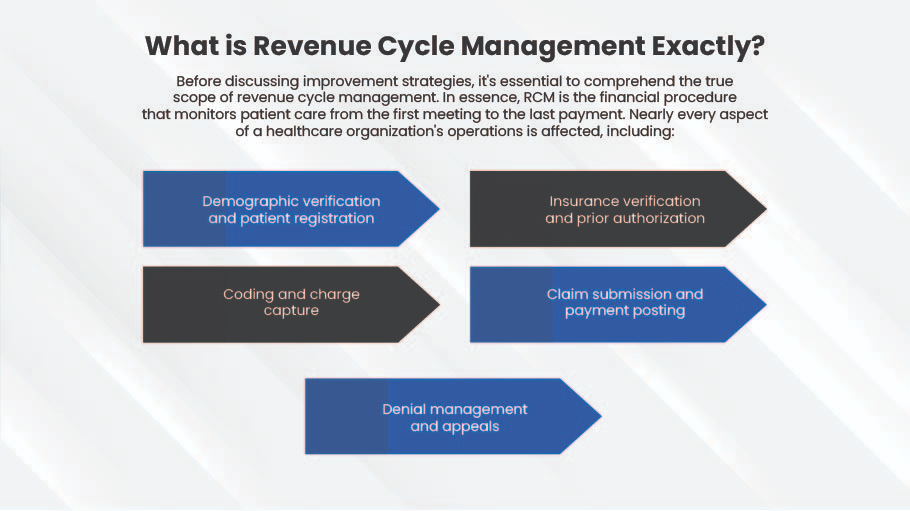
Before discussing improvement strategies, it’s essential to comprehend the true scope of revenue cycle management. In essence, RCM is the financial procedure that monitors patient care from the first meeting to the last payment. Nearly every aspect of a healthcare organization’s operations is affected, including:
When executed correctly, RCM ensures providers receive timely and accurate reimbursement for their services. Conversely, gaps in any step can lead to delayed payments, higher administrative costs, and even negative patient experiences.
Maximizing Efficiency with Revenue Cycle Management
Many healthcare setups choose to outsource or enhance their in-house processes with professional Revenue Cycle Management Services. These services bring knowledge, automation, and compliance knowledge that can make a huge difference.
Here’s why partnering with Revenue Cycle Management Services can improve your organization’s bottom line:
Whether handled in-house or outsourced, the goal is the same: a smoother, faster, and more reliable revenue cycle.
Effective Health Record Management is the cornerstone of successful Revenue Cycle Management. If patient facts are incorrect or incomplete, claims are likely to be denied, delayed, or underpaid.
A strong Health Record Management system facilitates numerous ways:
Linking Electronic Health Records (EHR) with Revenue Cycle Management Services enables groups to keep patient records accurate, speed up billing, reduce claim denials, and receive payments in a timely manner.
Improving RCM doesn’t have to be overwhelming. Here are some practical strategies that can make a significant difference:
One of the reasons claims are denied or delayed is insurance issues. Verifying insurance coverage before treatments can help patients understand their financial obligations, save time, and avoid mistakes.
Here’s what verifying insurance includes:
Many Revenue Cycle Management Services offer tools for real-time eligibility verification, making this process efficient and accurate.
Medical coding is the bridge between clinical services and reimbursement. Even minor mistakes can result in denials or underpayment. To improve coding accuracy:
Correct coding improves first-pass claim acceptance rates and ensures compliance with payer rules.
Today’s patients have greater financial obligations because of high-deductible plans. Clear billing communication improves collections and lessens confusion. Here’s what clear communication should include:
Improved communication reduces the likelihood of outstanding balances and improves patient satisfaction.
Denials are unavoidable, but how an organization responds makes all the difference. Proactively managing denials includes:
Many Revenue Cycle Management Services include analytics to monitor denials and optimize processes.
A well-integrated Health Record Management system ensures a smooth flow of accurate patient information between departments. Benefits include:
Training staff to use these systems efficiently enhances overall Revenue Cycle Management.
Automation is a game-changer in modern RCM. Common automation areas include:
Automating repetitive tasks reduces errors, saves staff time, and accelerates revenue collection.
Monitoring KPIs on a daily basis enables practices to point out issues and assess their progress.
Here are a few key RCM KPIs:
Keeping in mind these crucial metrics, businesses can continuously improve and modify their revenue cycle management processes.
Effective Revenue Cycle Management isn’t just about collecting payments quickly; it’s about creating a system that keeps the entire organization running smoothly. When done right, it strengthens financial health, lightens the load on staff, and builds trust with patients.
With streamlined processes, providers benefit from:
In short, strong Revenue Cycle Management lays the groundwork for growth, efficiency, and lasting success in healthcare operations.
Improving Revenue Cycle Management doesn’t have to be complicated. With the right Revenue Cycle Management Services and accurate Health Record Management, organizations can simplify billing, cut down errors, and run more efficiently. Focusing on insurance verification, correct coding, automation, and monitoring key metrics allows providers to maximize revenue, avoid denials, and keep patient care front and center.


IT Solutions and Managed Services Provider specializing in developing custom solutions.
 +1 (781) 667-5321
(021) 37447307
+1 (781) 667-5321
(021) 37447307
 info@techmatter.co
 100 N Brand Blvd Suite 522, Glendale, CA 91203, USA