
The biggest software development challenges in 2026 are talent shortages, technical debt, ungoverned AI-generated code, and legacy system integration. Fixing them takes a technical debt budget, mandatory human review of AI code, staff augmentation for skill gaps, and clear documentation before touching legacy systems.
Most engineering leaders don’t notice the moment a project starts slipping. Budgets look fine, sprints close on schedule, and the roadmap still says everything is on track, until a critical feature ships six weeks late and nobody can point to a single reason why. That gap between what teams plan and what they actually deliver sits at the center of the software development challenges and solutions conversation happening across the industry right now. According to the Stack Overflow Developer Survey 2024, 63% of professional developers named technical debt their biggest on the job frustration, and that single number explains a lot of what follows.
Most technology problems do not begin in the code. They begin in decisions made months earlier, when a team picked a shortcut to hit a deadline. A closer look at software development industry challenges 2026 shows talent shortages, AI governance gaps, and legacy integration at the top of nearly every survey.
Budget pressure makes it worse. Leadership wants faster releases. Engineering wants time to do the work properly, and something usually gives.
Four problems come up again and again when teams talk honestly about what slows them down. Each one has a workable answer, though none of them are quick fixes.
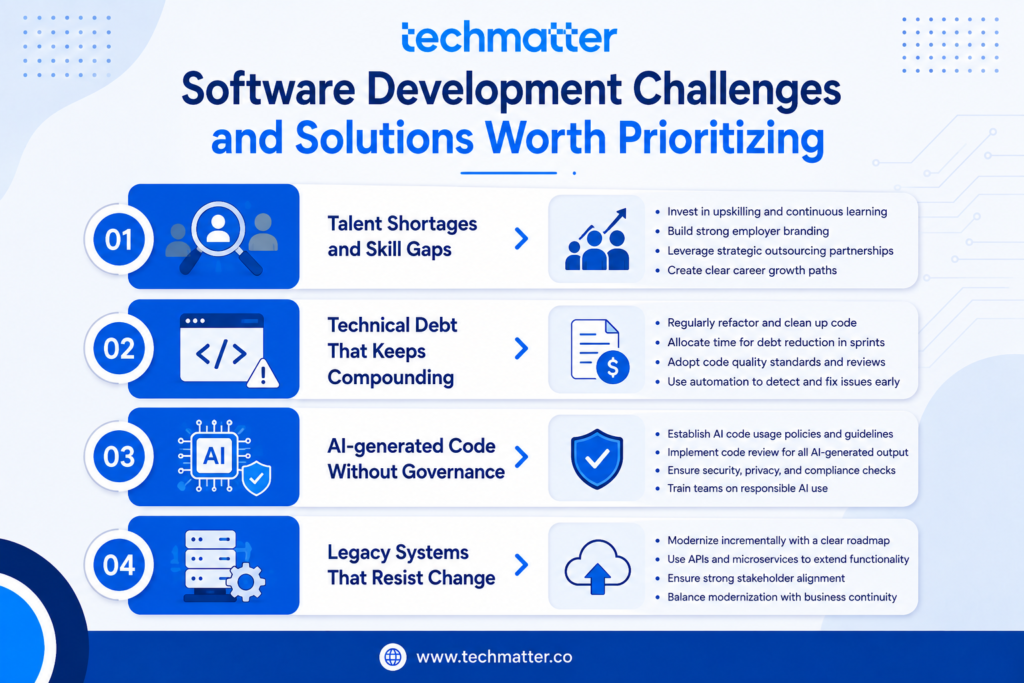
Finding senior engineers who understand both the technology and the domain, healthcare compliance, for example, takes months in most markets. Developing software for a regulated industry means the learning curve is steeper than a typical consumer app, and generalist hires often need extra ramp time before they contribute at full speed.
Debt does not announce itself. It shows up as a two-day task that quietly turns into two weeks. Left alone, software development challenges like this snowball until a routine update touches five unrelated systems.
AI tools write code fast, but fast is not the same as safe. Teams skipping review steps run into challenges in programming they did not have before, mostly around security gaps that manual testing used to catch.
Old systems were not built to talk to new ones. Every integration becomes a small negotiation between what the legacy platform can do and what the new feature actually needs, and these difficulties in software development rarely show up until testing begins.
Fixing these problems rarely means starting over. Most organizations solve challenges software development teams face by tightening a handful of specific practices rather than overhauling everything at once.
Not every project runs into the same obstacles at the same intensity. A startup MVP and an enterprise platform migration live in different worlds, even when both are technically software development work.
| Project type | Most common challenge | Practical fix |
| Startup MVP | Scope creep before launch | Lock a minimum feature set and defer everything else |
| Healthcare platform | Compliance and data security | Build audit trails into the architecture from day one |
| Legacy modernization | Integration with old systems | Map dependencies before writing a single line of new code |
| Enterprise rollout | Cross-department alignment | Assign one accountable owner per department |
The challenges of enterprise application development rarely stay contained to one team. A hospital system rolling out a new scheduling tool has to satisfy IT security, clinical staff, billing, and compliance all at once, and each group defines success differently.
This is also where the choice of partner matters most. Reliable application development software and a proven software development company reduce the number of surprises that show up mid-project, particularly around integrations with existing electronic health record systems.
Applications development in this space also demands a different testing rhythm. A missed edge case in a retail app costs a refund. A missed edge case in a billing workflow costs a denied claim, and that difference changes how much testing time a realistic timeline should include.
None of this means every organization needs a massive in-house team. TechMatter’s digital product development team works alongside healthcare organizations to close these exact gaps, from architecture reviews to production support, without asking a practice to rebuild its entire technology stack from scratch.
For teams looking at what other providers bring to the table, TechMatter‘s breakdown of leading software development companies walks through how vendor selection changes the outcome of a project before the first sprint even starts.
Software development challenges are not going away in 2026, and teams that budget for software development debt, review AI output honestly, and bring in outside help before a gap becomes a crisis tend to ship on time more often than the ones that do not. The organizations doing this well are not the ones with the biggest teams.
They are the ones treating software development challenges and solutions as an ongoing practice, and TechMatter has built its delivery model around that habit. Start by picking one recurring bottleneck from last quarter and fixing it this sprint, not on next year’s roadmap.
1. What are the most common software development challenges in 2026?
Talent shortages, technical debt, AI governance gaps, and legacy system integration top most industry surveys for 2026. These four issues compound each other, since understaffed teams often skip testing, which builds more debt and makes future integration work harder.
2. How can a small team manage technical debt without stopping new feature work?
Set aside a fixed share of each sprint, often 15 to 20%, specifically for cleanup. This keeps debt from accumulating silently while still allowing new features to ship on a predictable schedule.
3. Why does AI-generated code create new risks in software projects?
AI-generated code is not automatically reviewed the way human-written code is, which lets security gaps slip through. Requiring a second reviewer on every AI-assisted commit closes most of that gap without slowing delivery down much.
4. Is staff augmentation a better option than hiring full-time for a short-term project?
For a defined project window, yes, staff augmentation usually costs less and moves faster than a full hiring cycle. It lets a team add specific skills for the length of the project and scale back down once the work is done.
5. What makes enterprise application development harder than building a typical business app?
Enterprise projects usually involve more departments, stricter compliance rules, and integrations with older systems that were never designed to connect to anything new. Getting every stakeholder aligned on requirements early prevents most of the rework that follows.


IT Solutions and Managed Services Provider specializing in developing custom solutions.
 +1 (781) 667-5321
 info@techmatter.co
 100 N Brand Blvd Suite 522, Glendale, CA 91203, USA