
Quick Summary: Agile software development vs waterfall comes down to how much change a project can absorb mid-stream. Waterfall locks requirements before coding starts, which suits fixed-scope compliance work. Agile builds in short cycles with regular feedback, which fits healthcare software that shifts with payer rules, patient needs, and new regulations.
A hospital IT director recently scrapped a six-month billing platform rebuild after realizing the requirements had changed twice since kickoff. That kind of mid-project reversal is becoming normal in healthcare technology, where payer rules and compliance mandates move faster than a traditional build cycle can absorb. The debate over agile software development vs waterfall isn’t academic anymore. It shapes whether a practice ships a working product in three months or discovers, a year in, that the market moved without it. Most teams don’t pick a methodology on purpose. They inherit one from whoever built the last system, then spend the next two years wondering why releases keep slipping.
The waterfall methodology moves in one direction. Requirements get locked in first, then design, then development, then testing, then launch. Each phase finishes before the next starts, so a team can’t jump back to fix a missed requirement without reopening the whole sequence.
This works when the deliverable is fixed and well understood. A regulatory filing system, where the rules are set months ahead, is a good fit. It falls apart when scope needs to move, and scope moves constantly in healthcare software tied to reimbursement changes or new interoperability rules.
Agile organizes work into short cycles called sprints, usually one to four weeks long. At the end of each sprint, the team delivers something that works, gets feedback, and adjusts the next cycle based on that feedback.
This is the main difference in agile software development vs waterfall:
Put simply, agile vs waterfall comes down to timing. Agile gets feedback every couple of weeks. Waterfall gets feedback at the end, when it costs the most to make a change.
Agile teams use a few standard tools to support this:
This structure moves the control point earlier in the project. That matters a lot when comparing agile methodology vs waterfall for healthcare software, since a fixed waterfall gate can’t absorb a rule change that shows up mid-build.
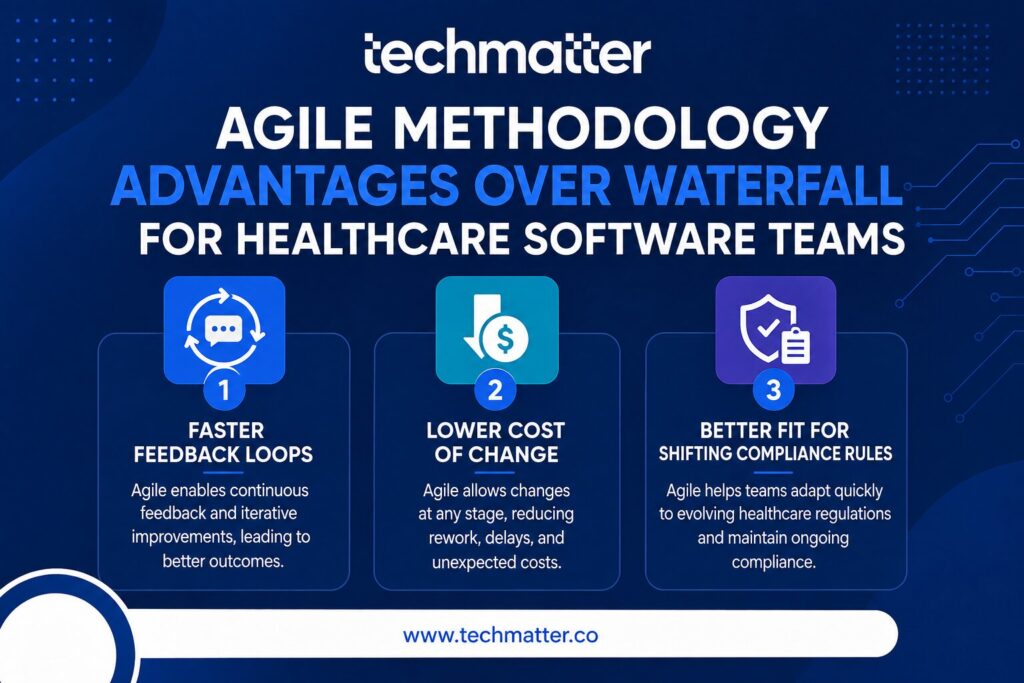
The agile methodology advantages over waterfall show up clearest once a project hits something unexpected, which happens often in healthcare software.
For a deeper look at why this shift happened, read our blog on why agile methodology is used in software development.
A sprint review happens every two weeks. If a clinician says the workflow doesn’t match how intake actually runs, the team hears it in week two, not month five. Waterfall hears it at user acceptance testing, often too late to fix without a budget fight.
Changing a requirement in sprint two costs a few hours of rework. Changing the same requirement after development is finished costs a re-open of design, build, and test. That gap widens the later a project sits in its lifecycle.
CMS updates, payer policy shifts, and new interoperability mandates don’t wait for a convenient release window. Agile’s shorter cycles give a team room to absorb a rule change without blowing up the whole roadmap.
Not every project needs the same answer. Here’s where the software development agile vs waterfall decision actually changes the outcome.
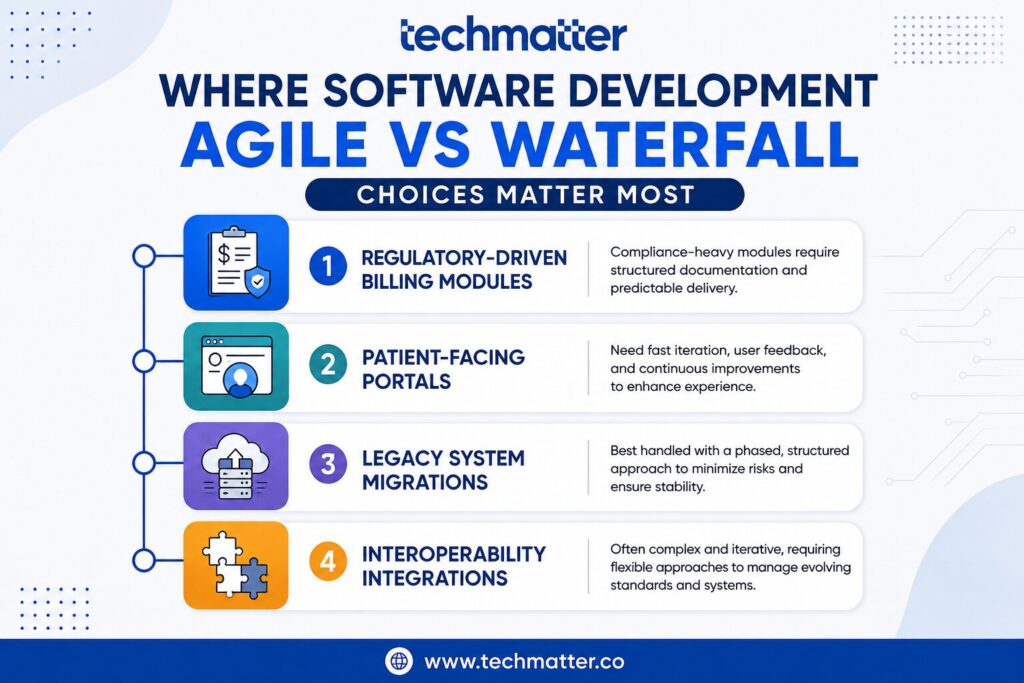
Looking at waterfall vs agile project management side by side makes the tradeoffs concrete instead of theoretical.
| Factor | Waterfall | Agile |
| Requirements | Fixed before build starts | Refined every sprint |
| Feedback timing | End of project | Every one to four weeks |
| Cost of late change | High | Comparatively low |
| Best fit | Fixed-scope, compliance-heavy builds | Evolving, user-facing products |
According to the Standish Group’s CHAOS Report 2015, Agile projects succeed 39% of the time compared to just 11% for Waterfall, and Waterfall projects fail more than three times as often (29% vs. 9%). This data is a big reason so many healthcare software conversations now start with agile vs waterfall methodology instead of defaulting to waterfall.
Choosing between the two isn’t about which model sounds more modern. It’s about matching the model to how much the project is likely to change once real users start using it.
Picking between agile software development vs waterfall isn’t a one-time decision. It depends on how fixed the requirements really are, and how much the regulatory landscape is likely to shift before launch. TechMatter builds both types of engagements for healthcare organizations, and covers the compliance side of that work in its Guide to Medical Software Development. The right fit usually becomes clear once a team reviews how often its requirements changed over the past year. Start there before committing to a model for the next build.
What is the main difference between agile and waterfall software development?
Waterfall finishes each phase, requirements, design, build, testing, before starting the next, with no return trips. Agile works in short sprints and revisits priorities constantly. The core difference is timing: waterfall plans everything up front, agile plans in small pieces and adjusts as it goes.
How long does an agile sprint typically last?
Most agile sprints run one to four weeks, with two weeks being the most common length in software teams. Each sprint ends with a working piece of the product and a review session where the team decides what changes for the next cycle.
Why is the waterfall method not as effective as agile for software teams?
Waterfall locks requirements before development starts, so any late-stage change means reopening finished work. Agile builds in feedback every few weeks, catching problems early when they’re cheap to fix. That gap in flexibility is why waterfall struggles on projects with shifting scope.
Can a team use both agile and waterfall in the same project?
Yes, this is often called a hybrid approach. A team might use waterfall for a fixed regulatory component and agile for a patient-facing feature within the same build. Weighing waterfall methodology vs agile on a section-by-section basis often works better than forcing one model across an entire project.
Which methodology is better for small development teams?
Small teams often do well with agile because sprint reviews and backlogs need less overhead than a full waterfall documentation cycle. That said, a small team building one fixed, well-defined deliverable can still succeed with waterfall if the scope truly won’t change.


IT Solutions and Managed Services Provider specializing in developing custom solutions.
 +1 (781) 667-5321
 info@techmatter.co
 100 N Brand Blvd Suite 522, Glendale, CA 91203, USA