Quick Summary: AI speeds up coding, testing, and documentation, but it also creates security gaps, code quality issues, and trust concerns. The pros and cons of AI in software development come down to one tradeoff: faster output versus the need for stronger human review at every stage.
A development team ships faster with AI tools. Then a bug slips through. Nobody caught it, because the code looked right, and nobody checked closely enough. That’s the tension sitting at the center of the pros and cons of AI in software development right now. Teams want the speed. Getting it without wrecking the quality bar? That part’s still unsolved for most of them. This post breaks down where AI actually helps, where it creates new problems, and how a team decides where to draw the line.
Repetitive, well-defined tasks are where the benefits of AI show up first. Boilerplate code. Unit tests. Documentation nobody wanted to write anyway.
Developers using AI coding tools report saving roughly 3.6 hours a week on average, according to DX’s developer analytics dataset, and that’s not a trivial number once you multiply it out.
A ten-person engineering team reclaims close to 36 hours a week doing that math. Some of that time moves toward architecture decisions.
Some moves toward code review, or the customer-facing feature nobody had bandwidth for last quarter. The advantages of AI aren’t just about raw speed, either. Junior developers lean on it to make sense of an unfamiliar codebase, and onboarding that used to eat two or three months now moves a lot faster.
Not everything benefits equally, though. Complex business logic, the kind built up over years of institutional memory nobody wrote down, still trips up most AI tools badly.
So the pros of AI are real. They just cluster around narrow, specific use cases instead of covering the whole development lifecycle. Teams already running a solid software development best practices checklist tend to fold AI in with a lot fewer surprises down the road.
Speed without oversight has a cost, and it’s usually a delayed one. The cons of AI in software development tend to surface in production, not before it, which makes the fix a lot more expensive than it needed to be.
Trust has actually dropped as adoption climbed, which is a strange thing to sit with. Stack Overflow’s 2025 survey put developer trust in AI accuracy at 29%, down from 40% the year before. That gap between how much people use it and how much they trust it? That’s exactly where the real problems with AI tend to live.
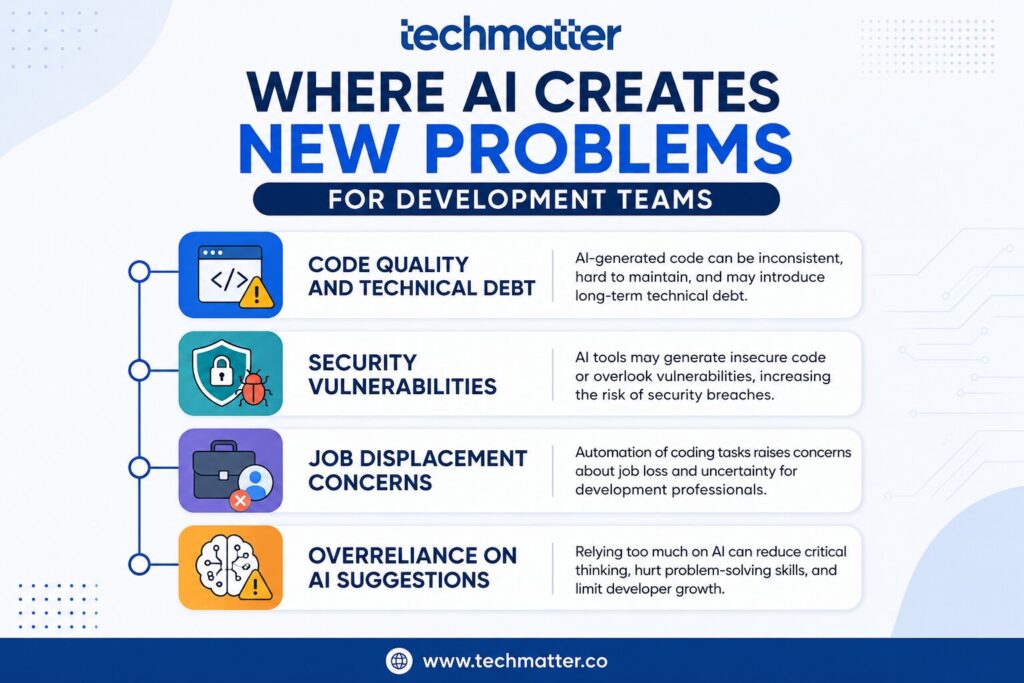
AI-generated code tends to duplicate patterns instead of designing something clean and reusable. Independent code analysis has found more issues meaningfully in AI-assisted pull requests than in fully human-written ones.
Nobody notices right away. Six months have passed. The codebase gets harder to maintain, and refactoring costs more than it would have if someone had reviewed each suggestion carefully the first time around.
AI models write code based on patterns they’ve seen, not on threat modeling. A meaningful share of AI-suggested code carries security weaknesses that need a human set of eyes before deployment.
Healthcare software raises the stakes further, since a patient data breach triggers regulatory penalties and reputational damage in the same breath.
Teams building in this space do better following an established medical software development guide, where security review gets built into the process instead of bolted on at the end. Skipping it to save a week is rarely worth what it costs later.
Developers worry about an AI robot writing code faster than they can and never once asking for a raise. That fear isn’t baseless. It’s also not the whole picture.
Entry-level hiring has slowed in some markets, and junior roles are shifting toward review and oversight instead of pure output. Senior engineers with sharp judgment stay hard to replace, mostly because judgment is exactly what current AI models don’t have.
The single biggest complaint developers report? AI output that looks almost right but isn’t. Nearly two-thirds call it their top frustration, and plenty say debugging AI-generated code eats more time than writing it from scratch would have.
That’s the overreliance trap in a nutshell. Someone stops questioning the suggestion, ships it, and only finds the error once something breaks three steps downstream.
Calling this AI vs human kind of misses the point. The teams getting real results treat AI as a tool a person directs, not something that replaces judgment.
| Task | AI strength | Human strength |
| Boilerplate code and tests | Fast, consistent output | Slower but context-aware |
| Complex business logic | Struggles without oversight | Understands nuance and edge cases |
| Security review | Flags common patterns only | Catches novel or contextual risks |
| Long-term architecture | Limited strategic reasoning | Plans for scale and maintainability |
Is AI good or bad? Framed that way, it’s the wrong question. For a software development company, the honest answer comes down to governance. Teams that pair AI tools with strict code review, security scanning, and clear ownership see real productivity gains, plain and simple.
Teams that skip those steps just to chase speed pay for it later. Usually, in production incidents. Sometimes, compliance issues carry even more weight in a regulated space like healthcare. The pros and cons of AI aren’t fixed in stone. They shift depending on how disciplined a team actually is about using the tool responsibly.
AI isn’t going away. Pretending otherwise just wastes energy that could go toward building good habits around it instead. The pros and cons of AI in software development boil down to something fairly simple: use it for speed on narrow tasks, keep humans firmly in charge of the judgment calls, and don’t skip review just because a deadline’s close.
TechMatter builds and maintains healthcare software with exactly that balance in mind, pairing AI-assisted workflows with the digital product development expertise that catches what automation misses.
The next step for any team is straightforward. Audit where AI already touches your codebase, and make sure a human still signs off before anything ships.
1. What are the main benefits of artificial intelligence in coding?
Speed on repetitive tasks, faster documentation, quicker onboarding for new developers. Those are the big three. AI handles boilerplate code and routine testing well, but it struggles once business logic gets complex and depends on judgment calls.
2. What are the disadvantages and advantages of using AI for development?
Speed and less repetitive grunt work, that’s the advantage. Security gaps, technical debt from duplicated patterns, and lower trust in output accuracy make up the disadvantages. Most teams find it worth the tradeoff, but only with a strong code review attached.
3. Are the AI pros and cons balanced enough to justify full adoption right now?
Not across the board. The artificial intelligence pros and cons split unevenly depending on the task. Repetitive coding work benefits a lot. Complex logic and security work still need a human holding the wheel. Full adoption without oversight tends to backfire fast.
4. How does a software development company measure real AI benefits?
Most track hours saved on repetitive tasks, defect rates showing up in AI-assisted code, and how much faster new hires ramp up. AI benefits show clearly in speed metrics. Quality metrics need their own separate, ongoing review.
5. Does AI replace human developers entirely?
No, and it’s not close. AI handles narrow, repetitive tasks well, but it lacks the judgment needed for architecture calls, security tradeoffs, or business context. Most engineering teams treat it as an assistant someone directs, not a stand-in for developers.


IT Solutions and Managed Services Provider specializing in developing custom solutions.
 +1 (781) 667-5321
 info@techmatter.co
 100 N Brand Blvd Suite 522, Glendale, CA 91203, USA