Choosing an electronic health record system for your practice is more than just a technical decision. It can directly affect your workflow, patient care, compliance, and overall efficiency. With so many options available, from cloud-based systems to specialty-specific platforms, the selection process can feel overwhelming. The key is to take a structured approach that considers your practice needs, budget, staff, and long-term growth.
An electronic health record system is more than a digital filing cabinet for patient charts. It is the central hub for patient information, scheduling, billing, and reporting. Selecting an inefficient system can result in workflow disruptions, frustrated staff, lost data and even compliance issues. On the other hand, selecting the right system improves efficiency, enhances patient experience, and simplifies Electronic Health Record Management.
The goal is to find a system that aligns with your practice’s unique needs while supporting your growth and providing a seamless experience for both staff and patients.
Before exploring vendors, evaluate your practice size, specialty, and patient volume. Different practices have different requirements. A small family clinic may need simple charting and scheduling, whereas a multispecialty clinic may require more advanced features such as integrated lab results, telehealth support, and billing automation.
Next, consider the workflows that drive your practice. These include scheduling appointments, documenting visits, processing claims, and generating reports. Understanding your workflow ensures your electronic medical record systems can adapt to your daily operations instead of forcing you to change the way you work.
Make a list of must-have features. Some examples include e-prescribing, lab integration, patient portal, telehealth capabilities, and reporting tools. Involving your team in this step helps identify the features that will truly improve efficiency and patient care.
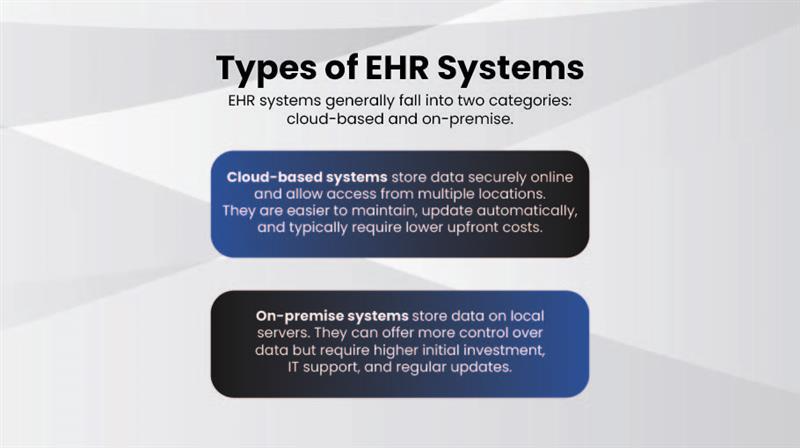
EHR systems generally fall into two categories: cloud-based and on-premise.
Some vendors offer specialty-specific solutions that cater to mental health, pediatrics, or cardiology. Selecting a system tailored to your specialty can save time and improve your staff’s productivity.
Safety and compliance are critical in healthcare. Make sure your system is fully HIPAA compliant and follows data protection regulations. Look for features like encryption, access controls, secure storage, and audit trails.
Regular backups and disaster recovery plans prove your practice is protected from data loss. A secure electronic health record system not only secures your patients but also safeguards your practice from legal and financial risks.
Evaluating Usability and Workflow Integration
An intuitive interface is essential for all users, including doctors, nurses, and administrative staff. The system should allow easy customization to match your workflow and integrate easily with other tools such as billing software, lab systems, and practice management platforms.
Ease of use impacts adoption rates and reduces errors. Engaging your team in the evaluation process ensures the selected electronic medical record system fits everyone’s needs.
Money is always a significant factor. Examine up-front costs, subscription fees, and any further expenses for upgrades or training. The long-term return on investment should be considered. In the end, an efficient EHR saves time and money by lowering errors, improving billing, and increasing efficiency.
Although buying an efficient system may seem costly at first, the advantages in terms of patient satisfaction and workflow efficiency sometimes exceed the expenses. The goal of electronic health record management is to gradually add value to your clinic, not just store data.
A reliable vendor makes a huge difference. Evaluate customer service, technical support availability, and the vendor’s experience in your specialty. Reading reviews, case studies, and testimonials helps you understand how the system performs in real-world scenarios.
Prompt support is critical during implementation and beyond. Good vendors also provide ongoing updates and training resources to ensure your system stays current and effective.
Never commit without testing the system (request a demo or trial period and involve your staff in the evaluation). Pay attention to usability, reporting features, workflow compatibility, and integration with your existing tools.
A hands-on trial allows you to identify potential challenges before investing. This step ensures that the electronic medical record systems you select meet all essential requirements and provide a smooth experience for both staff and patients.
Implementing a new EHR system requires careful planning. Prepare a timeline for data migration and staff training. Provide resources and support to minimize disruption to patient care. Proper training ensures everyone is comfortable using the system and maximizes its potential benefits.
Choose a system that can grow with your practice. Scalability, frequent updates, and compatibility with emerging technologies like telehealth and AI tools are important factors. The right EHR supports long-term growth, adapts to evolving regulations, and continues to enhance Electronic Health Record Management over time.
An electronic health record is a comprehensive system that tracks patient care across multiple providers, while electronic medical record systems usually store patient information within a single practice.
Proper Electronic Health Record Management ensures accurate, secure, and accessible patient information, improving workflow, compliance, and patient care.
It depends on your practice needs. Cloud-based systems offer easier updates and remote access, while on-premise systems provide more control but require higher maintenance.
Request demos and trials, involve your staff, and check for usability, workflow integration, and feature alignment with your practice requirements.
Look for HIPAA compliance, encryption, secure storage, audit trails, and regular backups to protect patient data and your practice.
Selecting the right electronic health record system is one of the most important decisions your practice will make. You can make an informed choice by evaluating your needs, understanding system types, ensuring compliance, evaluating usability, budgeting wisely, and testing vendors.
Remember, an EHR is not just a digital filing system. It is a tool for smarter practice management, better Electronic Health Record Management, and long-term success. Choosing wisely ensures your practice remains efficient, compliant, and patient-focused for years to come.


IT Solutions and Managed Services Provider specializing in developing custom solutions.
 +1 (781) 667-5321
 info@techmatter.co
 100 N Brand Blvd Suite 522, Glendale, CA 91203, USA