
Running a mental health private practice isn’t easy. You’re balancing the needs of your clients with the mountain of paperwork, billing, compliance, and scheduling. If you’ve ever wished you had more hours in your day, chances are you need a smarter system to manage your workflow.
That’s where a strong electronic health record (EHR) system comes in. The problem is that the majority of generic EHRs don’t adequately address the requirements of mental health professionals. You require something that is specific to your work style, clientele, and practice. What to look for, which platforms are worthwhile, and how to get started stress-free are all covered in this book.
You’re not jotting down blood pressure readings or lab results. Your notes are progress-based, client-centered, and tied to therapeutic goals. A specialized EHR understands that.
Mental health records are some of the most sensitive pieces of information a person can share. Your system must be built with HIPAA compliance, role-based access, and encrypted storage.
Whether it’s group therapy, couples counseling, or virtual check-ins, your schedule is complex. A good EHR should keep up without making things harder.
Look for flexibility. You should be able to create templates for SOAP notes, biopsychosocial assessments, and treatment plans without being boxed into someone else’s workflow.
Clients expect virtual care options. You shouldn’t have to jump between apps. The best EHRs have video built in, with automatic scheduling and secure session links.
If you’ve ever struggled with insurance rejections or forgotten superbills, you’re not alone. Choose a system that supports CPT codes, real-time eligibility checks, and claims submission.
Let clients handle appointment requests, payment, and paperwork online. It saves your team hours and keeps things organized.
This one’s popular for a reason. It’s clean, easy to navigate, and packed with features like custom intake forms, paperless billing, and a telehealth module.
Best for: Solo practitioners or small teams.
If documentation and insurance billing are top priorities, this system delivers. It even prompts you to complete notes after each session.
Best for: Practices that rely heavily on insurance reimbursement.
A solid choice if you’re growing. It handles group therapy, has great reporting features, and the customer service is consistently rated high.
Best for: Expanding practices or clinics with multiple providers.
Built with psychiatrists in mind, it combines behavioral and medical records in one system. You get robust scheduling, e-prescribing, and progress tracking.
Best for: Larger mental health organizations and psychiatric care.
Straightforward and efficient, Kareo focuses on helping small practices handle electronic claims, charting, and scheduling all from one dashboard.
Best for: Insurance-heavy practices that need quick billing tools.
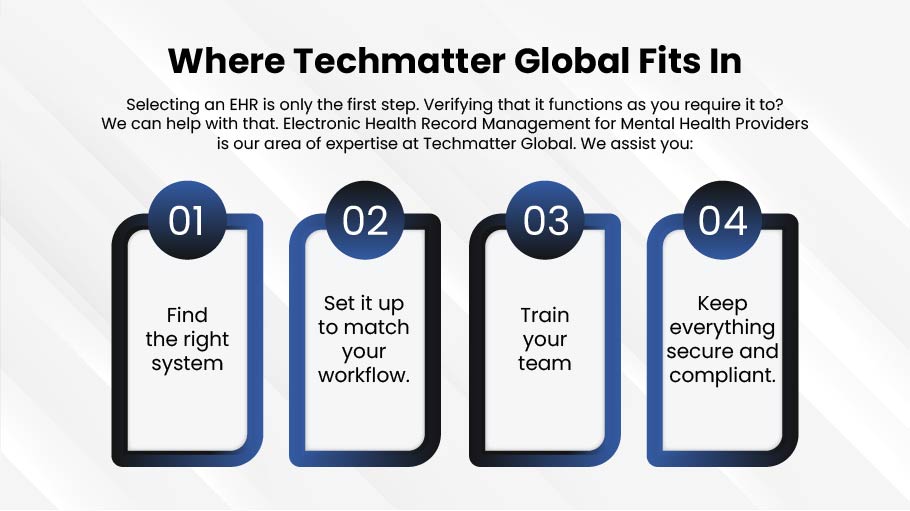
Selecting an EHR is only the first step. Verifying that it functions as you require it to? We can help with that. Electronic Health Record Management for Mental Health Providers is our area of expertise at Techmatter Global. We assist you:
You don’t have to figure it out alone.
If you’re unsure, we can help you evaluate all of that before you sign anything.
Cheap isn’t always better. If it lacks features you need, you’ll waste time and money fixing it later.
You won’t be the only one using the system. Include your staff in demos and feedback sessions before choosing.
Compliance is non-negotiable in mental health. A breach can cost you clients and your license.
Imagine having:
That’s what a well-chosen electronic health record system delivers. And when it’s properly managed and customized, the benefits go even further.
You don’t need to be a tech expert to run a modern practice. You just need the right support. Techmatter Global makes the process smooth from start to finish. From setup to ongoing Electronic Health Record Management, we help you save time, reduce errors, and grow confidently. Let’s talk about where you are today and where you want to be.
1. Can I switch from paper records to digital without losing data?
Yes. With the right support, you can migrate everything safely and securely.
2. How long does it take to set up an EHR system?
Most systems can be up and running in 2 to 6 weeks depending on your needs.
3. Is a mental health-specific EHR really necessary?
Absolutely. It makes documentation, billing, and compliance much easier and tailored to your field.
4. Do I need to hire someone just to manage the EHR?
Not always. But having a partner like Techmatter Global means your team can focus on clients, not tech issues.
5. Can I use the same EHR if I add more therapists to my practice?
Yes. Many systems scale easily. Just make sure your original setup allows for that kind of growth.
Choosing the best EHR isn’t about finding the flashiest software. It’s about choosing a tool that fits your day-to-day needs and helps you deliver better care without burning out. If you want something built for mental health providers, not just general clinics, you have great options out there.
And with Techmatter Global as your guide, you’re not just buying software. You’re building a smarter practice, one system at a time.


IT Solutions and Managed Services Provider specializing in developing custom solutions.
 +1 (781) 667-5321
 info@techmatter.co
 100 N Brand Blvd Suite 522, Glendale, CA 91203, USA