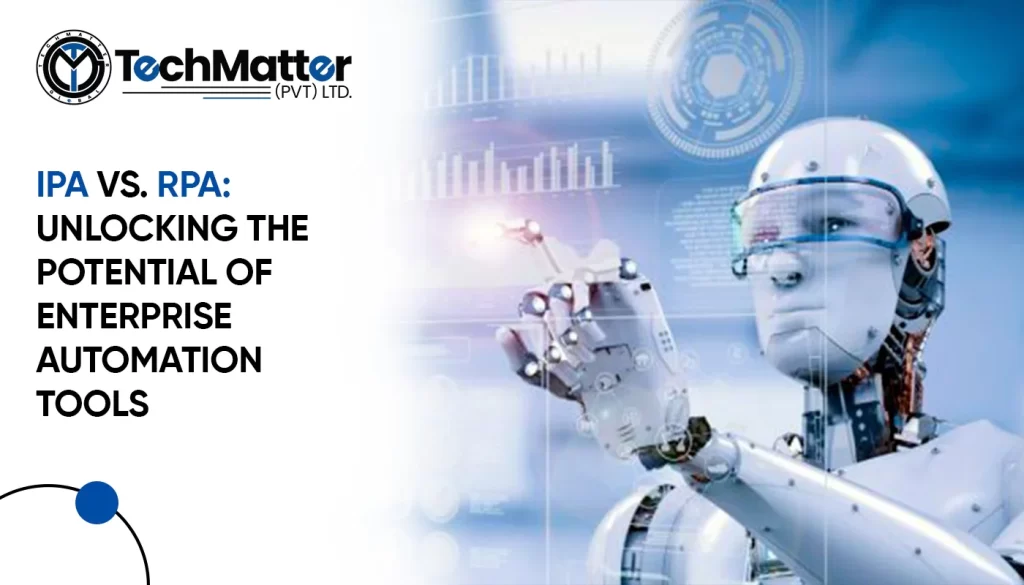
In today’s competitive world, businesses are turning to automation to simplify, speed up and save. Two of the automation solutions – Robotic Process Automation (RPA) and Intelligent Process Automation (IPA) – are key to this. While both are designed to improve workflow, they are very different in capabilities and use cases. Here, we look at RPA and IPA, what are their strengths and how each can contribute to successful automation.
Robotic Process Automation (RPA) focuses on automating repetitive, rule-based tasks. Through the use of software “bots,” RPA simplifies tasks such as data entry, document processing, and report generation. Its functionality is ideally suited for structured processes that follow a consistent pattern, where minimal human judgment is required.
Intelligent Process Automation (IPA) takes automation a step further by adding data processing and decision-making capabilities. IPA combines analytics and data interpretation so it can handle more complex workflows. With IPA, businesses can simplify data-driven tasks that require nuanced decision-making.

| Aspect | RPA | IPA |
| Functionality | Automates straightforward, rule-based tasks | Handles complex, data-rich processes |
| Complexity | Best for simple, repetitive work | Ideal for tasks requiring decision-making |
| Implementation | Relies on bots and structured data | Combines advanced processing and data analysis |
| Scalability | Limited adaptability | Adapts and learns from evolving conditions |
RPA is best for taking care of high-volume, tedious undertakings with negligible human intervention. Here are a few viable applications:
IPA is better suited for more nuanced and complex processes, especially those involving extensive data. Examples of IPA applications include:
When it comes to flexibility, RPA is generally limited to predefined parameters, whereas IPA is designed to adapt and refine its responses based on changing inputs. This adaptability gives IPA a clear advantage in dynamic business environments that require continuous process refinement.
RPA gives clear robotization to high-volume undertakings, succeeding in consistency but restricted to task execution with practically no flexibility. IPA, then again, offers dynamic handling capacities of real value, which empower it to smooth out processes that rely upon complex independent direction.
RPA handles structured data, fitting well with traditional databases and spreadsheets. In contrast, IPA can interpret unstructured data sources—emails, PDFs, and even images—allowing it to automate more data-intensive tasks and work with a broader range of inputs.
Both RPA and IPA are designed to integrate into existing business systems, but IPA’s flexibility allows it to handle a wider variety of systems and data types. IPA can easily connect with enterprise resource planning (ERP), customer relationship management (CRM), and data analytics platforms, making it suitable for complex data environments.
The expense of carrying out RPA is commonly lower than IPA, making it an appealing choice for organizations zeroed in on mechanizing more straightforward undertakings with a speedy profit from speculation. While IPA might have higher forthright expenses, its capacity to oversee complicated, versatile cycles frequently prompts more noteworthy long-haul esteem.
To begin using RPA:
When adopting IPA:
The preference between RPA and IPA depends on enterprise requirements. For notably structured, repetitive duties, RPA gives a price-powerful and efficient answer. For more complex workflows that rely on interpretation and evaluation, IPA is the suitable preference, supplying broader skills for lengthy-time period commercial enterprise optimization.
RPA and IPA both bring valuable efficiencies to modern businesses, with each offering unique benefits. While RPA handles routine, repetitive tasks efficiently, IPA elevates automation with advanced capabilities for handling complex, decision-based processes. By understanding the specific needs of your organization, you can determine which tool—or combination of tools—will best support your automation goals and contribute to long-term success.


IT Solutions and Managed Services Provider specializing in developing custom solutions.
 +1 (781) 667-5321
 info@techmatter.co
 100 N Brand Blvd Suite 522, Glendale, CA 91203, USA