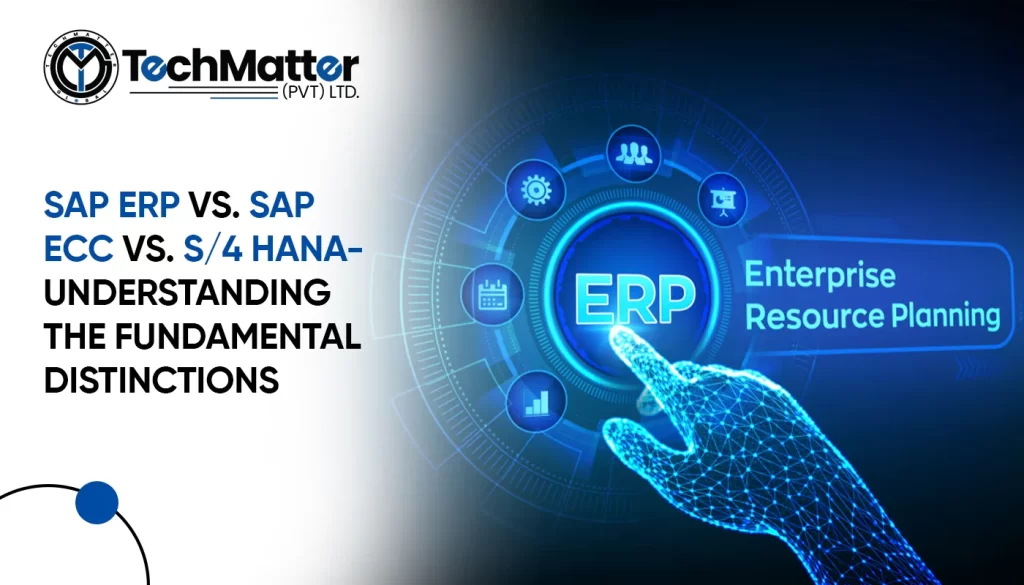
SAP’s vigorous and comprehensive business applications make it a significant player. Regarding the vast array of options available in the world of enterprise resource planning (ERP), two names consistently rise to the top: SAP ERP and its predecessor, SAP ECC (ERP Central Component).
This blog will delve into both offerings, providing you with a comprehensive analysis and detailed information.
Understanding SAP ERP
Key Takeaways:
- A highly dependable and stable ERP solution, SAP ECC has shown its dependability in a variety of industries.
- Though they refer to SAP, SAP ECC, and SAP ERP have their own unique features and architecture.
- In comparison to SAP ECC, which is more recent, SAP ERP offers better features and functionalities.
- A more intuitive user interface, simpler data models, and other advantages come with switching from SAP ECC to SAP S/4HANA.
- When implementing SAP S/4HANA, businesses must take a number of factors into account.
What does SAP ERP mean?
SAP ERP is an acronym for Systems, Applications, and Products in Enterprise Resource Planning. The German behemoth SAP developed this software tool to assist companies in managing their business operations.
What are SAP ERP functions?
The system’s numerous functional areas include finance, human resources, supply chain management, and CRM. Providing current information across departments simplifies processes, boosts productivity, and helps with decision-making.
- Financial Management: It can manage accounting, financial planning, budgeting, and cash flow management.
- Human Capital Management (HCM): Organizations may use this module to simplify their HR procedures, such as hiring, payroll, talent management, and workforce planning.
- Supply Chain Management (SCM): The administration of the whole supply chain, including procurement, inventory control, production scheduling, and logistics, is made more accessible.
- Sales and Distribution (SD): Businesses may successfully manage their sales operations due to this function, which includes order management, pricing, billing, and customer relationship management.
- Material Management (MM): The handling of materials, including procurement, inventory control, and warehouse management, is the main focus of the MM module.
- Production Planning: It offers production planning and control capabilities, enabling organizations to streamline their manufacturing procedures and effectively manage resources.
- Quality Management: By controlling quality inspections, control procedures, and monitoring quality-related data; this helps companies maintain quality standards.
- Plant Maintenance: Preventive maintenance, repair orders, and equipment tracking are all part of how it helps manage the care of structures, machinery, and assets.
- Project Management: With tools for project planning, execution, and monitoring, it enables businesses to monitor project progress, assign resources, and control project expenses.
- Reporting and Analytics: Due to the software’s extensive reporting and analytics features, businesses can produce insights, analyze data, and make wise decisions.
Benefits of SAP ERP:
Some key benefits are given as under:
- Integration and Centralization: A wide range of business operations, including finance, sales, procurement, production, and human resources, are covered by a complete suite of integrated modules offered. This integration enhances overall efficiency by enabling centralized data administration and facilitating smooth information flow across several departments.
- Streamlined Processes: Standardized procedures based on industry best practices are provided. Organizations may improve their workflow consistency, minimize unnecessary jobs, and simplify their operations using these practices.
- Real-time Analytics: Businesses can receive immediate insights into their operations because of the robust reporting and analytics tools it provides. This promotes resource allocation that is more effective, more informed decision-making, and better overall business performance.
- Scalability and Flexibility: Its scalability should expand with the company’s growth. It can accommodate large and small enterprises. The system may also be modified to meet specific business needs, giving it flexibility in adjusting to unique procedures.
Understanding SAP ECC
What is meant by ECC in SAP?
ECC stands for ERP Central Component in Systems, Applications, and Products. The primary part of Systems, Applications, and Product enterprise resource planning (ERP) software is called SAP ECC. It offers included capabilities to control different business operations.
What is the function of SAP ECC?
It has a range of modules and features that could be altered to meet the particular needs of various businesses and groups. Here are some essential functions and features it has:
- Key functionalities: Key modules and abilities for corporate business operations are offered. Finance, purchasing, sales, production, HR, and other operational sectors are also addressed. These modules optimize resource management and decision-making.
- Data management: Data management solutions allow businesses to store, manage, and analyze massive datasets. A central data repository enables data consistency across many functional areas. This integrated data structure offers real-time reporting, analytics, and informed decision-making.
- System integration: It integrates company systems and processes. Thus, cross-functional collaboration improves, and data silos eliminate. It facilitates module and external application data transfer. Its integration features enable complete operational visibility and control.
- Customization and flexibility: It offers various customization possibilities to adapt the system to meet unique company needs. Organizations can tailor the system’s settings, workflows, and procedures to suit their requirements. Due to its flexibility, it can accommodate many industry sectors and company structures.
- Industry-specific functionality: Its add-on modules provide capabilities tailored to specific sectors. These modules address the specialized needs of several sectors, including manufacturing, retail, healthcare, utilities, and more. Organizations may enhance operations and comply with laws by utilizing industry-specific capabilities and best practices.
- System stability: It has a long history of successful ERP implementations across industries. Its extensive testing, upgrades, and improvements make it a reliable business ERP system. Additionally, its stability ensures efficiency and reduces system issues.
Benefits of SAP ECC
Here are some of the key benefits of SAP ECC:
- Guaranteed Stability and Reliability: It has been a popular ERP solution for many years and has demonstrated its stability and dependability in multiple businesses across numerous sectors. It is renowned for its adaptability in managing complicated business operations and has a fully developed set of functions.
- Large-Scale Functionality: Various modules and features cover the essential capabilities most businesses need. These modules cover multiple topics, such as human resource management, sales and distribution, materials management, and production scheduling. Its broad capability meets a range of business objectives.
- Strong Community Support: A large and active user and development community supports, informs, and develops the ecosystem. Organizations adopting it may benefit from this community support since it assures access to information, best practices, and professional guidance.
- Smooth Transition to SAP S/4HANA: SAP The migration to SAP S/4HANA, the company’s next-generation ERP system, is based on ECC. When migrating to SAP S/4HANA, businesses utilizing SAP ECC may use their current investments and expertise, resulting in a more straightforward and productive transition.
- Business Intelligence (BI) and Reporting: Robust BI features are included, enabling users to build insightful reports, dashboards, and visualizations. This makes it easier for businesses to make data-driven decisions and allows them to notice trends, seize opportunities, and resolve problems more efficiently.
Is SAP ERP the same as SAP ECC?
Both the terms are related to SAP but not the same. The distinctions between both terms are given as under:
| Features |
SAP ERP |
SAP ECC |
| Architecture |
Service-oriented architecture with independent, interchangeable modules.
Uses web services and SOA principles. |
Monolithic architecture with tightly coupled modules.
Modules are dependent on a central database. |
| Functionality |
A broad ERP application suite covers multiple functions like finance, HR, supply chain, customer relationship, etc.
Additional industry-specific solutions are available. |
Focused on core ERP functions like finance and logistics.
Limited industry-specific solutions. |
| User Experience |
Modern, intuitive user interface with web-based tools
Mobile access available |
Older, less intuitive user interface.
Limited mobile access. |
| Scalability and flexibility |
Highly scalable due to modular architecture.
It can be adapted to specific business needs. |
Less scalable due to monolithic architecture.
Difficult to adapt to specific business needs. |
| Integration Capabilities |
Extensive out-of-the-box integration with 3rd party applications using standard interfaces.
Easier to customize integrations. |
Limited integration with 3rd party applications.
Difficult and costly to customize integrations. |
Why upgrade from SAP ECC to S/4 Hana?
Upgrades include rapid analytics speed, simplified data models, improved user experience, and modern technologies like machine learning and Internet of Things integration. It improves productivity and gives firms a digital edge. However, here are some of the critical migration causes.
Reasons to Migrate
S/4HANA provides a more user-friendly, cutting-edge, and intuitive user interface than ECC. By doing so, productivity rises, and user training time is reduced.
It improves system responsiveness and performance using in-memory computing to accelerate data processing and real-time analytics. It reduces the number of procedures and increases productivity by introducing a simpler data model.
Because it interacts with various platforms, businesses may employ emerging technologies like machine learning, artificial intelligence, and the Internet of Things (IoT) for innovation and competitive advantage. By moving to S/4HANA, SAP’s strategic platform for the future, businesses can take advantage of ongoing innovation, stay on track with SAP’s strategy, and profit from future advancements.
Challenges and Considerations
When migrating, several difficulties and challenges must be considered. Improved real-time data processing, better analytics, simpler data models, better system performance, and the capacity to make use of modern technologies like artificial intelligence and machine learning are some of these. Organizations may become more agile, efficient, and innovative by migrating to S4 Hana.
Benefits of Migrating to SAP S/4HANA
SAP S/4HANA offers various benefits that enhance the user experience and improve overall operational efficiency. Its intuitive and modern interface boosts productivity and user happiness.
Its in-memory computing capabilities enable real-time data access and analysis for speedier decision-making. It also simplifies IT by integrating systems and databases into a single platform, enabling more efficient operations. Additionally, the in-memory computing technology results in faster performance, accelerating data processing, reporting, and transaction processing.
Lastly, it improves visibility by providing a unified view of enterprise data, integrating various business functions, and enabling better insights into operations, finances, and supply chains.
Conclusion:
It is suggested to keep in mind that both these terms are two variants of the same software. While SAP ECC is an older edition, SAP ERP is the newer, more modern version. In comparison, SAP ERP offers improved features and functionality, making it a more reliable and complete option for businesses.



 +1 (781) 667-5321
 info@techmatter.co
 100 N Brand Blvd Suite 522, Glendale, CA 91203, USA