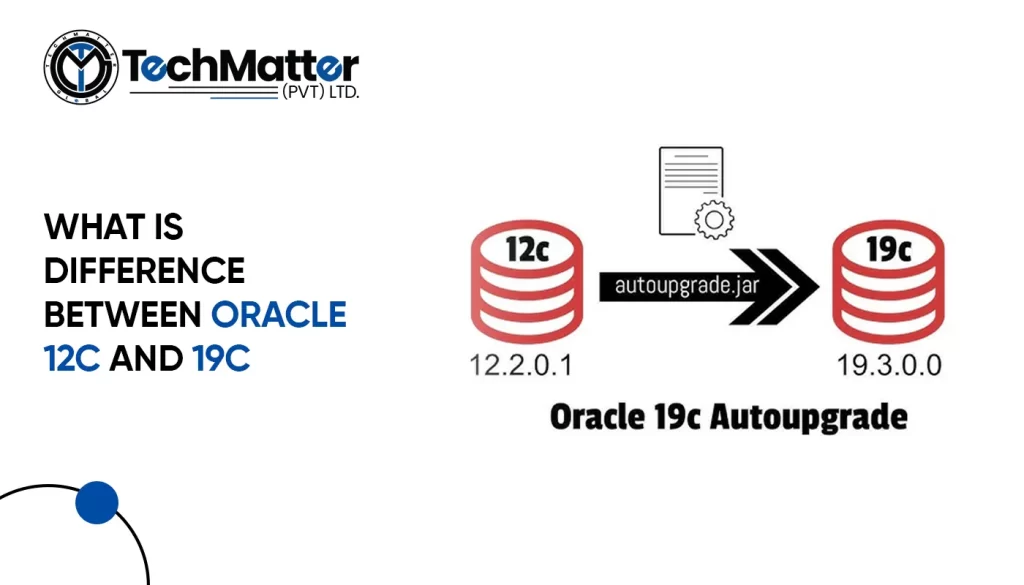
Greetings from the Oracle realm, my fellow explorers! Oracle 12c and Oracle 19c are two mighty titans, and today we set out on a thrilling journey to investigate their intriguing differences.
These versions, each with unique charms, represent crucial turning points in the development of the Oracle Database. So, let’s get started.
Oracle Database 12c is specifically created to meet the needs of the database infrastructure of the 21st century. Oracle Database 12c provides efficiency while enhancing user service levels by combining the capacity to consolidate and deliver the agility of a service-oriented platform via in-database virtualization.
With support for various server and storage hardware platforms, Oracle Database 12c is a heterogeneous relational database management system that operates on Windows, Linux, and Unix.
The 12c Oracle’s relevant features for the developers are provided as under:
Making users’ transitions to the cloud simpler is a critical component of Oracle Database 12c’s design. Without needing any application modifications, the multitenant architecture is intended to simplify consolidation. Consolidation is a crucial step in becoming cloud-ready. Rapid provisioning and transfer capabilities are made possible by the pluggable databases.
As a result, self-service provisioning and database as a service are both excellent uses for Oracle Database 12c.
The latest long-term release, Oracle Database 19c, offers the highest level of release stability and the most time for support and issue fixes. It is the last release of the Oracle Database 12c family of products, including Database 18c, and is therefore considered to be in “long-term support.”
“Long-term support” includes at least 3 years of extended assistance and 4 years of premium support. It will be supported through 2023, with Extended Support going until 2026, equivalent to 12.2.0.3.
Clients have access to a multi-model enterprise-class database suitable for a wide variety of everyday operations with the additional features introduced in this edition, including the following:
Since Oracle 19c replaces Oracle 12c, there must be significant distinctions between the two. Here are some important differences between these two databases:
| Oracle 19c | Oracle 12c |
| Oracle 19c database has a long-term support commitment | Oracle 12c database does not offer long-term support commitment |
| The new database provides more security features than Oracle 12c | Offers lesser security comparatively. |
| Up to 4,096 pluggable databases (PDBs) can be supported by a single container database (CDB) in Oracle 19c. | 252 pluggable databases are available for Oracle 12c. |
| It offers support for in-database ML, but Oracle 19c support is vast comparatively. | Oracle 12c provides support for in-database machine learning but at least 19c. |
| It is a relational database with advanced features, making it a multi-model database. | It is a relational database with JSON support which is a non-relational feature. |
Compared to Oracle 12c, which boasts ground-breaking capabilities like pluggable databases and multitenant architecture, Oracle 19c has better performance, more security, and seamless cloud integration. Both are impressive, but 19c’s tricks leave you spellbound. So, if you seek a database that combines innovation with enchantment, 19c is your captivating choice.
FAQ’s
Yes, both may be installed on the same machine.
Yes, both are back-compatible.
It is possible to upgrade from 12c to 19c.
The maximum size varies by edition, with the Enterprise Edition’s maximum size set at 128 terabytes.
The C stands for “Cloud”.


IT Solutions and Managed Services Provider specializing in developing custom solutions.
 +1 (781) 667-5321
(021) 37447307
+1 (781) 667-5321
(021) 37447307
 info@techmatter.co
 100 N Brand Blvd Suite 522, Glendale, CA 91203, USA