Key Points
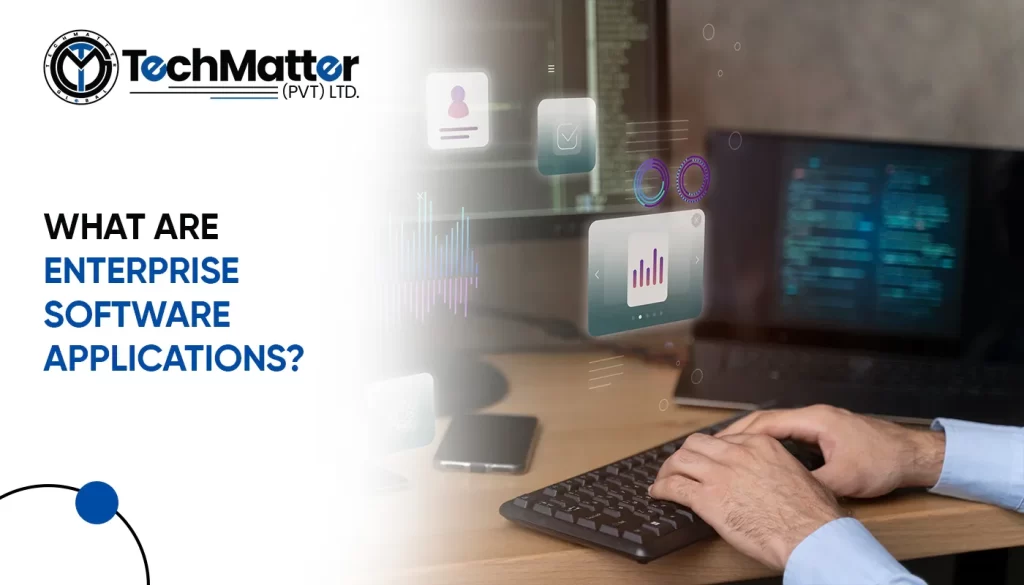
An enterprise application (EA) is a comprehensive software platform for use in a corporate setting, such as a business or government. It is designed to integrate all phases of a company’s operations and computer systems, enabling collaborative workflows and reducing the complexity of large projects.
With the emergence of enterprise application development, businesses can now create customized applications that meet their specific requirements. For many companies that rely on such software, it is of utmost importance as any failure in the system could have disastrous consequences on their business operations.
Each enterprise has unique needs that require specific solutions tailored to their industry and business. For instance, if you are a pharmaceutical enterprise, you may require a system to manage customer relationships effectively. On the other hand, a software development company may need an enterprise planner to manage resources, payroll, and other important employee details. These are just some essential needs that any enterprise must fulfill to succeed in today’s market.
Almost all businesses need these 5 types of enterprise solutions. Let’s explore them.
Managing human resources can be tedious and time-consuming, as businesses often have to invest significant time in mundane tasks to achieve desired results. With the advent of automation, HRM tools have been introduced to streamline these tasks. By automating these tasks, businesses can free up their employees to focus on finding and attracting the best talent. This is crucial for any enterprise that wants to hire professional and knowledgeable employees to help make their company the best it can be. Human resources management is the foundation of all these challenges.
Introducing business intelligence tools into your enterprise can bring your organization a new level of intelligence. By gathering data and converting it into actionable information, these tools offer strategic advantages that can help you gain a competitive edge. With logical reasoning and analytical findings, BI provides the right data to support effective decision-making.
Managing the proper flow of services and goods, including raw materials and packed items, is the essence of supply chain software. SCM is a process that oversees the workflow of products from start to finish, ending with final delivery. Using SCMs, businesses can monitor marketing and sales KPIs, streamline processes, and increase profits. For retail and eCommerce businesses, supply chain management and logistics are essential tools to help them create long-term strategies that benefit the enterprise.
CRM Software is crucial for delivering a satisfactory customer experience. CRM software is particularly designed to store customer data with intricate detail, which can increase sales, promote enterprise, and improve customer satisfaction. Essentially, CRM is like a brain for businesses, allowing them to manage all data and deliver exceptional results meticulously.
Enterprise Resource Planning (ERP) is a systematic process of gathering and digitizing all the information in a system into different modules. This creates a simplified network between multiple departments, allowing everyone in the company to operate off of a centralized database and receive real-time updates. By implementing ERP Software, all businesses can streamline their tasks and operations, improve communication and collaboration across departments, and ultimately increase efficiency and productivity.
Enterprise application software undoubtedly differs from other types of software in several key ways.
As a result, while business software encompasses a wide range of applications, enterprise software refers to a subset of business software designed specifically for large enterprises needing reliable applications that can be easily implemented across the firm.
For you to understand, some of the most significant distinctions are highlighted below.
| Enterprise Application Software | Other Software |
| Scope and Complexity: These application software provide a wide range of features and are created to meet the needs of huge enterprises. These also include supply chain management (SCM), customer relationship management (CRM), enterprise resource planning (ERP), and more. | The scope and complexity of other software can vary considerably. It may be simple to use and concentrated on a single activity or set of features, like word processing or graphic design software. |
| Customization and Integration: To address the unique demands of an organization, enterprise apps are frequently highly adaptable. Additionally, they must smoothly interface with the enterprise’s other systems and databases. | The customization choices for some software, such as consumer-oriented apps, may be restricted, and these programs often do not need a lot of database or software interaction. |
| User Base: These are intended for usage in corporations and organizations and cater to the requirements of the management, staff, and frequently external stakeholders. | Other software can frequently be created with single users or small user groups in mind. They might lack the user management and scalability features needed for enterprise applications. |
| Cost: These can be expensive in terms of licensing and implementation costs. They often require significant financial investments. | Other software, especially consumer software, is typically more affordable or even free in some cases. |
| Support and Maintenance: To ensure the software’s dependability, performance, and updates over time, enterprise applications frequently include specialized support and maintenance services.
|
Consumer software may have limited support and maintenance; thus, users may need to contact user communities or forums for assistance. |
| Scalability: Enterprise applications must be scalable to meet an organization’s expanding and shifting needs. They frequently accommodate a huge user base and high transaction volumes. | Other software might not need the same level of scalability as they are designed for individual or small-group use. |
The techniques and procedures employed to promote the growth and adoption of enterprise software applications within organizations are called the growth model for these applications.
As the year progresses, the growth has been assessed; please see the graph below for your reference.

The Bottomline


IT Solutions and Managed Services Provider specializing in developing custom solutions.
 +1 (781) 667-5321
(021) 37447307
+1 (781) 667-5321
(021) 37447307
 info@techmatter.co
 100 N Brand Blvd Suite 522, Glendale, CA 91203, USA