Businesses are always looking for methods to improve their operations, save costs, and gain a competitive advantage. “Offshore” and “nearshore” are two phrases that are frequently used while discussing outsourcing tactics. However, what do these phrases actually represent, and how do they affect businesses?
Get ready to understand the complexities of these outsourcing techniques and obtain insightful knowledge about their benefits and drawbacks.
Anyone who has ever thought about developing a digital product has undoubtedly come across these terms. Frequently, companies can’t fulfill their needs in human resources because hiring experts in their city or country is simply too expensive. So, they opt for outsourcing.
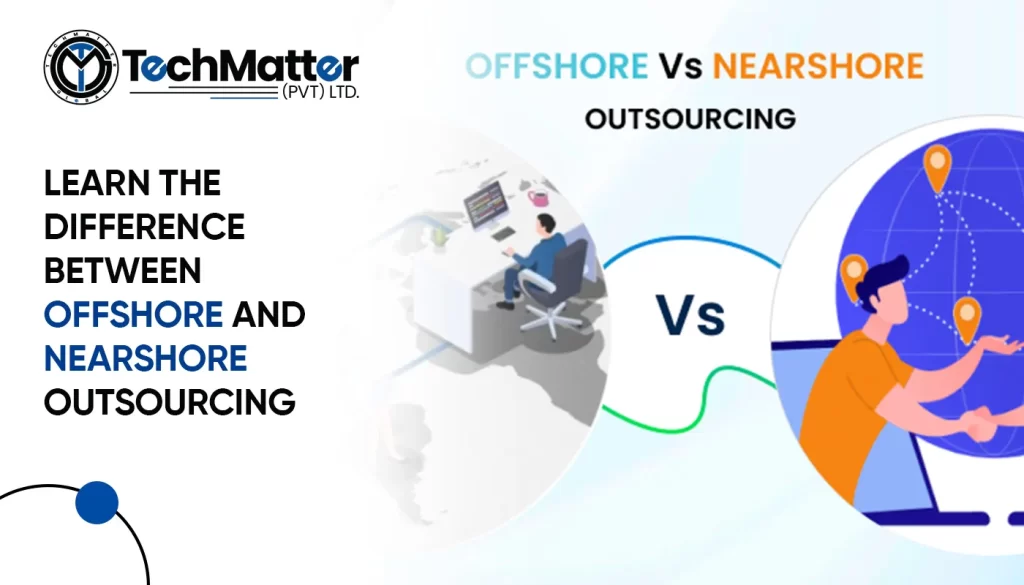
In its most basic form, outsourcing to a firm offshore means sending work to a distant country, frequently one with a large time zone difference, whereas outsourcing to a company nearshore means sending work to a nearby country or time zone.
There are major noticeable differences between both of these out-sourcing terms. Let us have a deep look into them.
| Offshore | Nearshore |
| The practice of outsourcing commercial tasks or services to a company in a different nation, usually in a different time zone and frequently a great distance away, is known as offshore outsourcing. | Contracting with or working together with a business based in a neighboring or adjacent nation, sometimes in the same or a comparable time zone. This close proximity is helpful for communication and transportation. |
| Typically, it is done to acquire specialized skills, cut labor costs, or develop companies internationally. | In addition to many of the same advantages of offshore outsourcing, it also has the advantages of simpler coordination, comparable cultural concepts, and the possibility for cost savings due to lower travel and communication costs. |
| It’s possible that the service provider and the outsourced organization have major linguistic, cultural, and legal differences. | The decrease of linguistic and cultural barriers makes collaboration and information transfer easier and more efficient. |
| Compliance with different legal frameworks and regulations may require additional understanding and effort. | Familiarity with comparable legal frameworks and regulations, which simplifies and reduces the complexity of compliance activities.
|
You have more control over your intellectual property when you hire nearby developers. Additionally, there’s a good chance that you and your vendor are subject to the same data privacy rules, which enables you to avoid uncertainties and dangers while crafting a contract.\
During development, you may need to contact your vendor for clarification or progress updates. Do you wish to see the developers before signing a contract or learn more about the business? Sure thing! The vendor is conveniently located close by, allowing you to pay a quick visit anytime you choose.
It often involves countries with similar or compatible cultures and languages, which can lead to a better understanding and alignment of work culture, values, and expectations.
Closer time zones and geographical proximity can lead to quicker response times and shorter project delivery times, allowing organizations to bring products or services to market faster.
It typically offers the most significant cost savings due to lower labor costs in countries with lower living standards. This cost advantage can be especially attractive for labor-intensive tasks. Far-offshore locations pay competent developers roughly 50 percent less per hour than developers in the US, UK, Canada, etc.
Experts in many disciplines and technologies are available. To fulfill your project’s needs, you may learn any relevant technical skills promptly. In addition, Eastern European countries that attract IT companies spend heavily on their engineers’ STEM and computer science education. You may, therefore, confidently engage top-tier IT professionals without breaking the bank.
It reduces the need for in-house infrastructure, training, and management, leading to cost savings in various operational aspects.
It can help companies establish a global presence, diversify risk, and access new markets by leveraging local knowledge and networks.
Certainly! Both offshore and nearshore outsourcing include their own set of dangers and challenges. Following are a number of the risks associated with both forms of outsourcing:
Quality Control
Maintaining the same degree of quality manipulation and oversight as in-house teams can be hard. Quality may also go through if the outsourcing accomplice’s requirements and approaches are not aligned with your personal.
Data Security
It may additionally contain sharing sensitive business information with 1/3 parties. Data breaches or protection lapses can arise if proper safety features and protocols are not in place.
Legal and Compliance Issues
Legal and regulatory structures vary by means of the United States. Failure to comply with those necessities may result in legal trouble, penalties, or emblem harm.
Talent Shortages
It might also enjoy expertise shortages in specific talent units, mainly due to opposition for skilled professionals and potential resource constraints.
Cost Variability
While the locations can be value-effective, economic fluctuations in those regions can affect the price advantage over time.
Political and Economic Stability
It may additionally contain countries with political or financial instability that may introduce uncertainties and dangers on your commercial enterprise operations.
Vendor Dependence
Over-reliance on a nearby accomplice can create vulnerabilities, mainly if the associate encounters financial or operational difficulties.
The decision between offshore and nearshore outsourcing is influenced by a variety of elements, including language demands, cultural fit, proximity, and economic concerns.
Offshore outsourcing examples
Nearshore outsourcing examples
These examples show how businesses may decide to off-shore or near-shore particular tasks or offerings in order to take advantage of cost savings, get access to specialized expertise, or simplify operations.
Conclusion
We hope you have gained a deeper understanding of the captivating differences between these two strategies. However, your decision to outsource can be a pivotal moment for your business, unlocking new avenues for growth, efficiency, and success.


IT Solutions and Managed Services Provider specializing in developing custom solutions.
 +1 (781) 667-5321
(021) 37447307
+1 (781) 667-5321
(021) 37447307
 info@techmatter.co
 100 N Brand Blvd Suite 522, Glendale, CA 91203, USA