Network security is paramount to companies today, where cyber risks continually increase. Networks and data are, first and foremost, protected from unwanted activity by firewalls. Traditional firewalls need help to keep up with advanced cyber threats as technology advances.
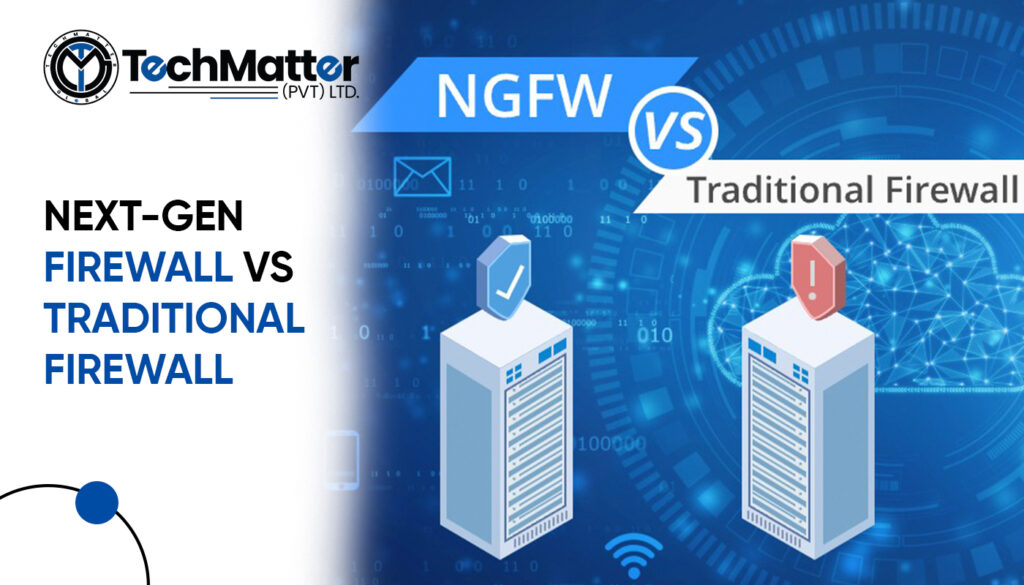
This article compares traditional firewalls to next-generation firewalls (NGFWs), highlighting how NGFWs offer better protection for an expanding threat scenario.
Let’s examine both in detail.
The foundation of network security has long been traditional firewalls, also known as stateful inspection firewalls. To decide whether to allow or restrict traffic, they work by looking at packet headers and checking the status of network connections. Traditional firewalls are excellent at enforcing simple access control rules based on IP addresses, ports, and protocols. Still, they must thoroughly examine application-layer data and recognize more complex threats.
DPI technology enhances network security in next-generation firewalls. This enables application-layer visibility into network traffic by analyzing network packets. NGFWs can identify specific applications, users, and even individual functions within applications, allowing for more precise control over network access.
Next-gen firewalls often integrate intrusion prevention capabilities, which go beyond traditional firewalls’ simple allow/block decisions. IPS functionality will enable NGFWs to identify and block known and emerging threats in real-time, using signature-based and behavior-based detection techniques. By actively monitoring network traffic, NGFWs can detect and prevent unauthorized access attempts, malware, and other malicious activities.
To combat the ever-evolving threat landscape, NGFWs employ advanced threat intelligence mechanisms. These include integration with threat intelligence feeds, reputation-based analysis, and behavioral analytics. NGFWs can leverage these capabilities to proactively identify and mitigate potential security risks, even before they become widely recognized threats.
Next-gen firewalls prioritize user-centric security, offering granular control over user access. NGFWs can enforce policies based on individual user identities by integrating with authentication mechanisms such as Active Directory. This enables organizations to implement role-based access control (RBAC) and enforce security measures tailored to each user’s privileges and responsibilities.
NGFWs provide a holistic view of network traffic, allowing administrators to gain insights into application usage, user behavior, and potential security threats. This visibility enables organizations to make informed decisions regarding network access and resource allocation, enhancing overall security posture.
With their advanced threat intelligence capabilities, NGFWs are better equipped to detect and mitigate emerging threats. By combining signature-based detection, behavior analysis, and real-time threat intelligence feeds, NGFWs can significantly reduce the risk of successful cyberattacks.
Next-gen firewalls often feature centralized management consoles that streamline security policies and configuration management. This ease helps administrators monitor network security and respond quickly to new threats, relieving IT staff.
In conclusion, your organization’s needs determine whether to use a next-gel, a classic firewall. A next-gen firewall may be preferable for advanced safety features like application control, user identity awareness, and intrusion prevention. Traditional firewalls may be superior to basic firewall systems. Research and pick an option that matches your company’s security demands.


IT Solutions and Managed Services Provider specializing in developing custom solutions.
 +1 (781) 667-5321
(021) 37447307
+1 (781) 667-5321
(021) 37447307
 info@techmatter.co
 100 N Brand Blvd Suite 522, Glendale, CA 91203, USA