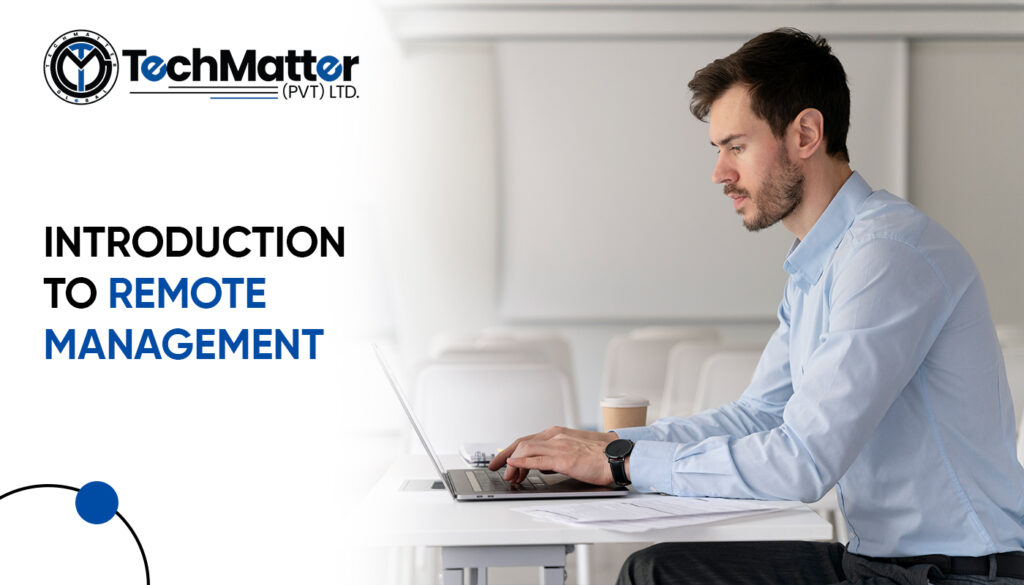
“Remote management” refers to managing computers or networks remotely. Installing software and controlling all actions on a client’s system network, workstations, or servers may be done remotely with this method. It also allows for endpoints to be managed. IT workers are responsible for maintaining and managing the inventory of all servers, computers, and other equipment located both on-site and off-site. However, depending on various remote connection programs and password managers is not only wasteful but also unpleasant and dangerous. IT workers, system administrators, and help desk specialists are forced to deal with continual turmoil rather than being allowed to benefit from simplified clarity. The idea is to concentrate all of the remote connection technologies, remote machine data, password management, and access control on a single platform that is safe, scalable, and surprisingly easy to use.
The information technology firms of today are not just “local enterprises,” which is particularly true of managed service providers. For instance, an administrator may be in charge of a network that spans many states and regions; in this case, tracking all of the machines and endpoints in the network might be challenging.
Here are a few advantages of choosing IT remote management for your company.
RMM offers particular advantages in each of the following four domains:
Unexpected IT downtime has a detrimental short- and long-term effect on companies. Downtime quickly decreases income, and some organizations can’t complete transactions without IT. During a system outage, employees can’t access customer data, causing a loss of trust that takes time to recover.
Terminal services can identify issues before they affect users, preserving their desktop experience.
Even for relatively modest enterprises, safeguarding information technology is rapidly becoming an issue of paramount significance. Especially in sectors like healthcare and banking, several government rules detail the safeguards companies are obligated to implement to secure their client’s personal information.
Regular IT maintenance may be handled through remote monitoring and management software (RMM). One of the most typical responsibilities of RMM administrators is installing and updating software. This is made possible by remote desktop web access. Furthermore, this feature allows administrators to monitor the system’s general health to address potential performance issues that might result in longer response times.
Productivity gains from using an RMM are particularly crucial for expanding firms. Customers may use a thin client with this IT management solution since all their information and programs are hosted in the cloud. Users may take advantage of many displays with the help of a virtual desktop, which is something an RMM solution can give. Such proficiency is expected in many different types of work, particularly in engineering and visual design.
The following are some strategies that an efficient remote manager may use to overcome these possible challenges, regardless of whether they are managing hybrid or entirely remote teams.
Because numerous tools are used for remote management, we list the most common instruments you will come across below. The software that does remote monitoring and management (RMM) might have additional features. The following tools make it easier for managed service providers and other IT administrators to administer remotely:
Because remote work is becoming increasingly prevalent, businesses prioritizing working remotely must develop a remote work policy checklist to manage their distributed teams more effectively. Trust us when we tell you the remote work policy checklist you need is what we have here at Tech Matter Global since we assist startup owners in developing effective remote work strategies.
Our RMM solutions and support enable customers to remotely control network endpoints, PCs, mobile devices, and the complete IT infrastructure from a centralized interface. This is one of the many benefits of working with Tech Matter Global. It has capabilities of the highest level. It is not possible to find a more economical solution than that.


IT Solutions and Managed Services Provider specializing in developing custom solutions.
 +1 (781) 667-5321
(021) 37447307
+1 (781) 667-5321
(021) 37447307
 info@techmatter.co
 100 N Brand Blvd Suite 522, Glendale, CA 91203, USA