Let’s face it, healthcare isn’t just about caring for patients. It’s also about keeping the business running. That’s where Revenue Cycle Management (RCM) comes into play. For practices of all sizes, especially in a competitive and regulation-heavy market like the U.S., RCM isn’t optional; it’s essential.
Whether you are operating a multi-location healthcare company or a tiny clinic, knowing and improving your RCM process might be the difference between a successful business and one that barely makes ends meet. You’re at the proper position if you want to increase profitability, decrease claim denials, or get more control over your billing procedure.
Revenue cycle management is the act of monitoring and controlling all clinical and administrative tasks related to processing claims, making payments, and generating income. From the moment a patient schedules an appointment to when the final payment is collected, RCM touches every stage.
But here’s where it gets even more valuable: Effective Revenue Cycle Management Solutions don’t just handle billing. They reduce errors, speed up payments, and ultimately increase the bottom line.
Many confuse RCM with billing. While billing is a piece of the puzzle, RCM is the full framework.
Picture it like this: Billing is the engine, but RCM is the whole car, including the wheels, steering, and GPS.
Medical Billing Services typically focus on submitting claims and processing payments. RCM, however, goes deeper. It involves verifying insurance, checking for authorization requirements, coding diagnoses using ICD Codes In RCM, scrubbing claims for errors, appealing denials, collecting from patients, and providing detailed reporting.
So if you’re just “billing,” you’re leaving money and efficiency on the table.
Let’s break it down into steps:
Everything starts here. This includes appointment scheduling, collecting demographics, and verifying insurance. If done wrong, the rest of the revenue cycle is built on shaky ground.
Pro tip: Real-time eligibility checks cut down on rejected claims later.
Is the patient covered? Is pre-auth required? Failure to answer these upfront can mean immediate revenue loss. Techmatter Global recommends automating this step for better results, as it’s where delays often originate.
Providers must document care accurately and consistently. Missed services = missed revenue. Using smart EHRs integrated with your Revenue Cycle Management Solutions ensures nothing gets lost between care and billing.
This is where ICD Codes in RCM come in. The patient’s diagnosis and treatments are represented by these standardized codes, which guarantee that insurance companies know what was done and why it should be reimbursed.
Errors in coding are one of the top reasons for denials. That’s why trained medical coders and coding audits are critical.
The likelihood of a clean claim being paid on the first attempt is the highest. Claim cleansing software comes in handy in this situation. Before submission, it looks for compliance issues, mismatched codes, and missing information.
One missed modifier or a wrong ICD code? That’s a denial.
Not every claim gets paid the first time. But that doesn’t mean it’s a loss. Denied claims should be tracked, corrected, and appealed quickly.
A responsive denial management strategy is a hallmark of top-performing Medical Billing Services. Techmatter Global’s RCM experts prioritize reworking denials with fast turnaround and high resubmission success rates.
Accurate and timely posting of insurance and patient payments is required. This phase helps find underpayments, duplication, or write-offs and guarantees that accounts are current. Automated posting tools speed up this process, reduce errors, and improve cash flow visibility.
Many patients are now responsible for a larger portion of their healthcare costs. That means clear, understandable billing is a must. Want fewer overdue balances? Make it easy to pay through online portals, SMS reminders, and card-on-file options.
You can’t improve what you don’t measure.
A strong Revenue Cycle Management Solution should give you access to reports on claim aging, denial rates, collection percentages, and more.
And if you’re partnering with an external vendor, like a Medical Billing Services provider, you should expect complete transparency and monthly performance reviews.
At Techmatter Global, we don’t just view RCM as a back-end function; we see it as a growth engine. Our team integrates Revenue Cycle Management Solutions into your existing workflows or builds custom ones to scale with you.
We understand the challenges providers face: staff shortages, rising patient deductibles, increased claim rejections, and stricter compliance rules. That’s why we take a hands-on approach.
From implementing clean coding protocols (yes, including compliant ICD Codes In RCM) to building denial dashboards and predictive analytics, our RCM model is built for performance.
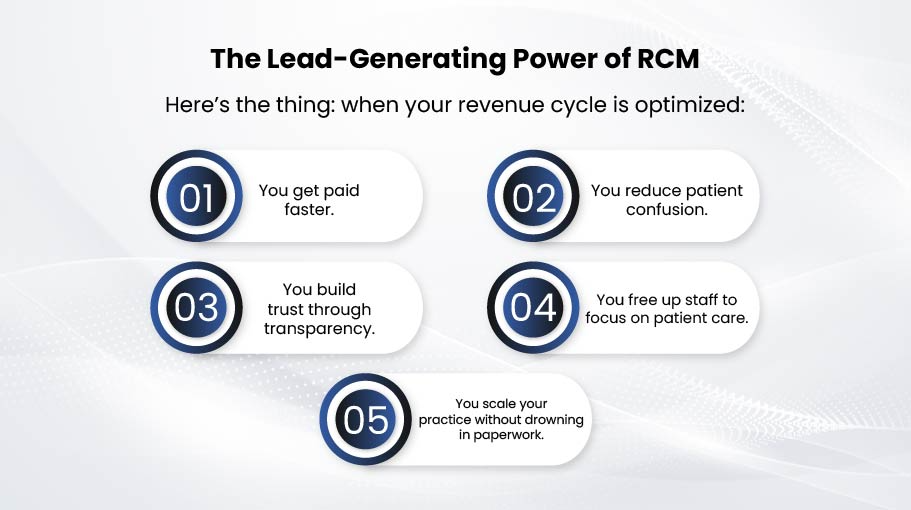
Here’s the thing: when your revenue cycle is optimized:
That’s exactly what your future clients (or partners) want to hear. And that’s what sets your practice apart from the rest.
Still relying on outdated billing systems or fragmented software? Or maybe your front-desk team is stretched too thin to keep up with eligibility checks and billing follow-ups?
Now is the time to reassess. Whether you need a full-service Medical Billing Services provider or want to upgrade your internal workflows with robust Revenue Cycle Management Solutions, the ROI is worth it.
Let Techmatter Global show you how optimized RCM can turn financial chaos into clarity. Our deep expertise in ICD Codes in RCM, claim lifecycle management, and patient billing strategy means you’re not just surviving, you’re scaling with confidence.


IT Solutions and Managed Services Provider specializing in developing custom solutions.
 +1 (781) 667-5321
 info@techmatter.co
 100 N Brand Blvd Suite 522, Glendale, CA 91203, USA