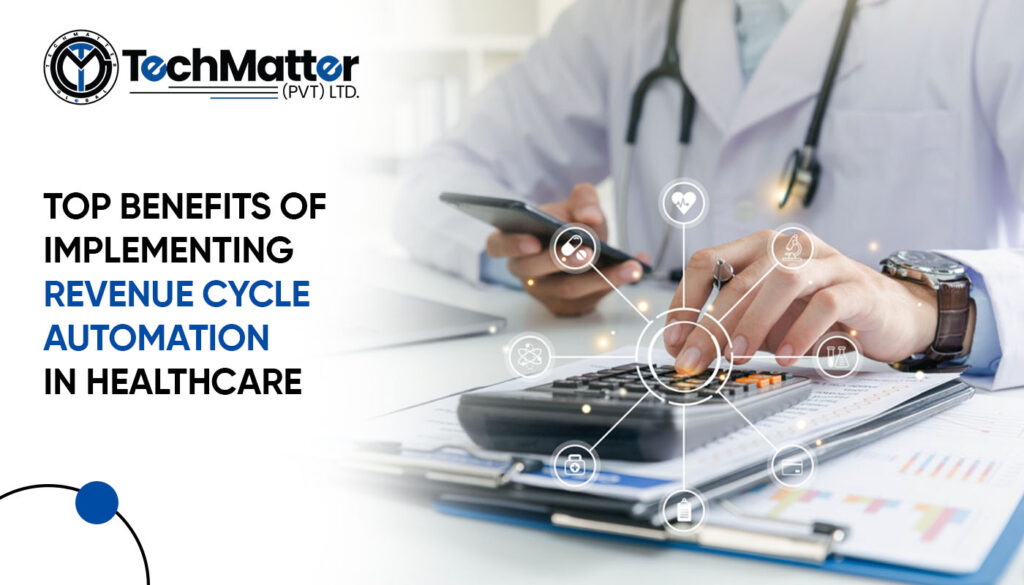
Revenue Cycle Management (RCM) is the foundation of financial health in medical care organizations. It includes all regulatory and clinical capabilities that add to catching, making due, and gathering patient assistance income. With the rising intricacy of healthcare billing and the interest in working on persistent encounters, income cycle robotization has arisen as a unique advantage. However, what precisely is income cycle robotization, and for what reason is it so valuable?
Learn more about Steps in Revenue Cycle Management (RCM)
Revenue cycle automation insinuates using advanced programming deals with robotize different pay cycle parts, from patient enlistment and charging to portion collection and data examination. This advancement utilizes man-made awareness (reenacted insight) and artificial intelligence (ML) to streamline processes, reduce manual mix-ups, and further develop capability.
One of the most quick advantages of income cycle robotization is the smoothing out of charging processes. Manual charging is inclined to blunders, which can prompt postponements and lost income.
Mechanization essentially diminishes the gamble of human blunder by guaranteeing that information is precisely caught and handled. This prompts fewer case dismissals and dissents.
With automated systems, billing cycles are expedited. Claims are submitted quicker, and payments are received faster, improving cash flow.
Revenue cycle automation doesn’t just benefit the healthcare provider; it also enhances the patient experience.
Automated systems provide patients with timely and accurate information about their bills and payments. This transparency builds trust and reduces confusion.
Patients can easily access their billing information online, which simplifies the process and makes it easier for them to understand and manage their healthcare expenses.
Automation can have a substantial positive impact on a healthcare provider’s financial performance.
By accelerating the billing cycle and diminishing mistakes, revenue cycle automation keeps a consistent income. This is basic for the financial stability of any medical care supplier.
Automating repetitive tasks decreases the requirement for broad physical labor, prompting lower functional expenses. Staff can zero in on additional essential exercises that enhance the association.
Healthcare providers must adhere to strict regulatory standards, and revenue cycle automation can help ensure compliance while enhancing data security.
Automated systems are regularly updated to comply with the latest regulations, reducing the risk of non-compliance and associated penalties.
With cutting-edge security highlights, automated frameworks safeguard delicate patient data from breaks and unapproved access.
Automation upgrades, by and large functional effectiveness via automating repetitive tasks and guaranteeing consistent joining with existing frameworks.
Tasks, such as information passage, arrangement booking, and billing, can be automated, opening up staff to zero in on additional complicated liabilities.
Automated solutions can be integrated with current EHR and practice management systems, ensuring smooth operation and data consistency.
Accurate claims processing is crucial for revenue generation, and automation plays a pivotal role in this area.
Automated systems accurately capture and verify information, leading to fewer claim denials and increased revenue.
Automation speeds up the goal of denied claims by distinguishing and rectifying mistakes rapidly, guaranteeing that cases are handled sooner rather than later.
Revenue cycle automation gives admittance to ongoing examination, empowering better independent direction.
Providers can access cutting-edge financial information and execution measurements, taking into account informed choices and vital preparation.
With detailed investigation, medical services suppliers can figure out future financial performance all the more precisely, assisting with arranging and designate assets effectively.
Automated revenue cycle management systems are scalable and flexible, catering to the evolving needs of healthcare providers.
As healthcare practices grow and change, automated systems can easily adapt to new requirements without significant disruptions.
Automation supports the expansion of healthcare practices by ensuring that revenue cycle processes can handle increased patient volumes and complexities.
A seamless and transparent billing process can significantly enhance patient satisfaction and loyalty.
Patients appreciate the ease of automated billing and payment options, leading to higher satisfaction and loyalty.
By reducing billing-related stress and confusion, automation contributes to a more positive overall patient experience.
Several healthcare providers have successfully implemented revenue cycle automation, yielding significant benefits.
Examples of healthcare institutions that have seen improved financial performance and patient satisfaction through automation.
Insights and best practices from organizations that have implemented revenue cycle automation.
While the benefits are substantial, there are challenges to consider when implementing revenue cycle automation.
Possible obstacles include integration issues, staff resistance, and the initial investment cost.
Strategies to overcome challenges include thorough planning, training programs, and selecting the right technology partner.
Revenue cycle automation is changing the medical services industry by working on financial performance, upgrading patient encounters, and guaranteeing compliance. As innovation keeps on developing, the advantages of mechanization will just develop, making it a fundamental speculation for medical care suppliers planning to flourish in an undeniably complicated climate.
Income cycle robotization utilizes progressed programming answers to mechanize different parts of the income cycle, including charging, claims handling, and installment assortment.
It upgrades patient correspondence, gives straightforwardness in charging, and improves installment processes, prompting higher fulfillment and devotion.
Computerization lessens functional expenses by limiting difficult work and blunders, prompting further developed income and monetary strength.
Potential dangers incorporate coordination challenges, introductory expenses, and staff obstruction, yet these can be relieved with legitimate preparation and preparation.
Suppliers ought to begin by assessing their ongoing cycles, choosing the right innovation accomplice, and carrying out a staged way to deal with coordinate robotization arrangements.


IT Solutions and Managed Services Provider specializing in developing custom solutions.
 +1 (781) 667-5321
 info@techmatter.co
 100 N Brand Blvd Suite 522, Glendale, CA 91203, USA