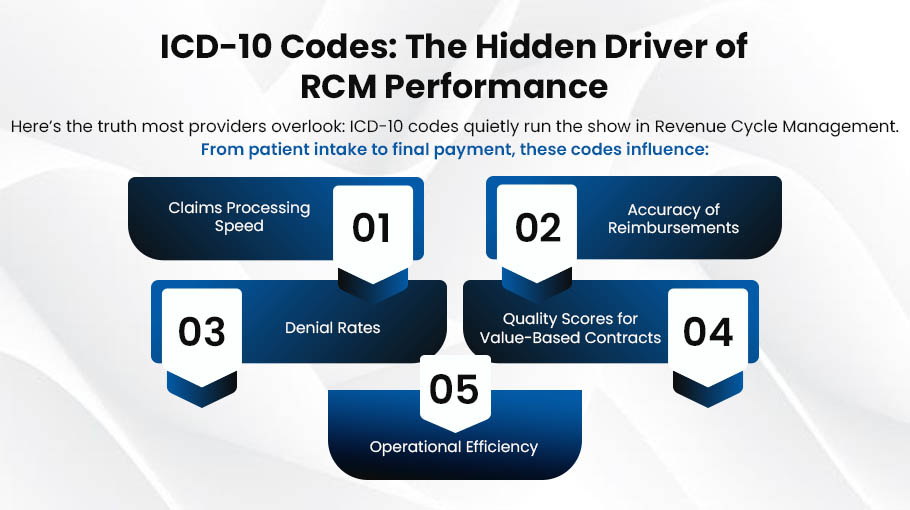
Accurate coding determines how efficiently a healthcare organization gets paid. It affects claim speed, reimbursement accuracy, denial rates, compliance, and long term financial sustainability. ICD 10 codes are not just medical codes for documentation. They influence every step of the revenue cycle. Practices that use proper coding techniques and modern tools such as icd 10 diagnosis codes lookup systems, automated scrubbers, and integrated RCM platforms see faster payments and fewer billing complications.
ICD 10 introduced significant improvements compared to older code sets. With tens of thousands of highly specific diagnosis codes, healthcare providers now document patient conditions with far more accuracy. This level of detail supports clear communication with insurers and strengthens medical necessity for billed services.
Accurate ICD 10 coding benefits RCM by improving three main areas:
When every diagnosis is documented using the correct medical codes, billing teams can submit clean claims with fewer errors. Clean claims move through payer systems more easily, which increases cash flow and reduces administrative costs.
Improved medical billing efficiency starts with coding clarity. ICD 10 gives healthcare providers the precision needed to support detailed and error free claim submission. Below are the major ways ICD 10 impacts real world RCM performance.
Claim denials happen for one main reason: incomplete or vague documentation. ICD 10’s detailed structure eliminates ambiguity. When diagnosis descriptions match clinical documentation perfectly, payers have fewer reasons to reject claims.
Clean claims lead to:
Practices that use automated scrubbing tools and icd 10 diagnosis codes lookup platforms verify codes before submission. This strengthens billing accuracy even further.
Modern Revenue Cycle Management Solutions rely on automation to handle repetitive billing tasks. When ICD 10 codes integrate with EHRs, claim scrubbers, eligibility tools, and clearinghouses, the workflow becomes more efficient.
Automation benefits include:
Instead of digging through paperwork or manually searching codes, your billing team can focus on higher level tasks. Automation is now essential for practices that want consistent revenue and operational efficiency.
Prior authorizations slow down treatment and billing. ICD 10 streamlines this because payers rely heavily on diagnosis specificity to confirm medical necessity.
Specific coding leads to:
Practices supported by Revenue Cycle Management Services typically see smoother authorization processes because coding specialists know exactly how to document medical necessity.
Even with accurate coding, denials cannot be avoided completely. However, ICD 10 makes it easier to fix denials and prevent similar issues in the future.
Detailed ICD 10 codes help teams:
RCM platforms use machine learning to predict which codes are most likely to face denial. This gives practices a chance to fix errors before submission.
Healthcare is shifting toward value based care models. Risk adjustment scoring heavily depends on precise diagnosis coding. The more accurately you capture the severity of a patient’s condition, the more appropriate the reimbursement.
Effective ICD 10 coding helps:
For organizations participating in ACOs or Medicare Advantage, this accuracy directly impacts revenue.
Many practices lose revenue because of small coding errors that go unnoticed. Some of the most common mistakes include:
Regular audits, training, and technology tools ensure these issues are corrected early.
Healthcare organizations can strengthen their coding accuracy using the steps below.
ICD 10 updates every year. Training ensures teams stay compliant and avoid costly mistakes.
Automated tools help verify codes, check payer rules, and identify documentation gaps. Functions such as icd 10 diagnosis codes lookup make coding faster and more accurate.
Outsourcing coding and billing to experts reduces errors and improves cash flow without adding internal workload.
Audits uncover:
This prevents future denials and improves monthly revenue.
Modern RCM platforms amplify the value of ICD 10 codes using technology, data, and automation.
Automated systems verify diagnostic accuracy, scrub claims, and catch coding mistakes before submission.
Some platforms use AI and NLP to automatically recommend ICD 10 codes based on clinical notes. This reduces manual coding time and improves consistency.
Analytics dashboards monitor claim approvals, denials, and reimbursement timelines. These performance insights help healthcare leaders optimize workflow and revenue strategy.
The complexity of healthcare billing continues to grow. Payers update policies every year, ICD codes expand, and compliance rules become harder to follow.
Revenue Cycle Management Services provide:
Practices that invest in RCM support gain long term financial stability and faster collections.
ICD 10 is here to stay, and its importance will grow as technology evolves. The future of coding includes:
Healthcare organizations that upgrade to modern RCM systems will see the strongest financial improvement in the coming years.
ICD 10 codes are essential for the speed, accuracy, and overall success of medical billing. They influence cash flow, claim approvals, risk adjustment, and operational efficiency. By adopting strong coding practices, using icd 10 diagnosis codes lookup tools, and integrating advanced RCM solutions, healthcare organizations can reduce denials, improve revenue capture, and create a more efficient billing environment.
Stop thinking of ICD 10 codes as just administrative tasks. When used correctly, they are one of the most powerful tools for building a strong and predictable healthcare revenue cycle.


IT Solutions and Managed Services Provider specializing in developing custom solutions.
 +1 (781) 667-5321
 info@techmatter.co
 100 N Brand Blvd Suite 522, Glendale, CA 91203, USA