Electronic health record (EHR) systems combine patient records or medical data from several health care providers into one system. This makes it easy for providers to communicate with one another by enabling encrypted messaging and sharing patient records.
EHR systems help health care organizations with information management, care coordination, clinical communication, and clinical decision support. By decreasing medical errors and enhancing clinician workflow, they enhance patient care. Health care providers can avoid Medicare/Medicaid reimbursement fines and satisfy meaningful use rules with the support of a strong electronic health record system.
9 Major Types of Electronic Health Record Systems that are now on the market are described in this guide. Knowing this, we’ll go over the key characteristics to consider when choosing EHR software or looking to customize EHR software for your company.
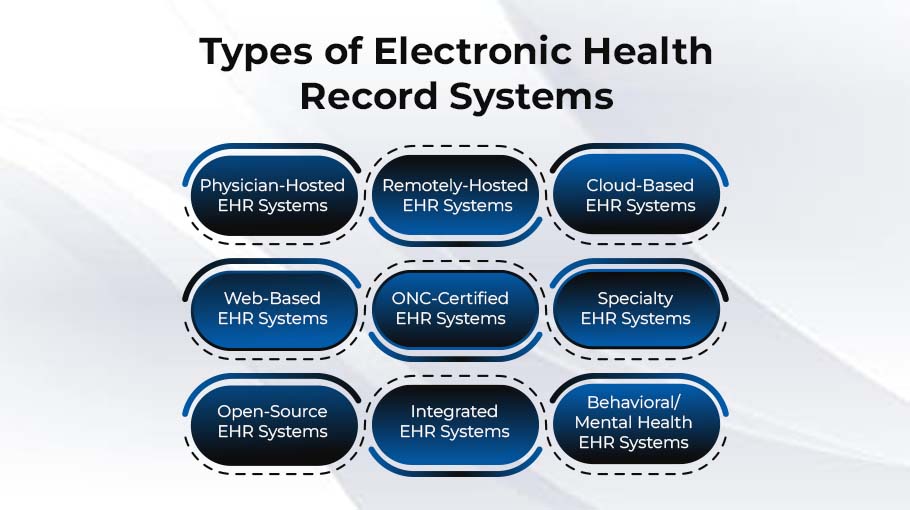
Let’s dive into the 9 major types of EHR systems you’ll find in today’s healthcare landscape:
These systems are hosted on a server physically located at the physician’s office. The healthcare provider maintains full control over the data and system operations.
Ideal for clinics that prefer in-house data storage and have the resources to maintain their own IT infrastructure.
These are managed off-site by a vendor or third-party provider, allowing healthcare professionals to access data from multiple locations.
Great for growing practices that need to expand access across multiple facilities or teams.
Accessible from anywhere with an internet connection—no need for local servers or hardware.
Vendors handle updates, backups, and security. It’s like having an IT team without the payroll.
No software installations are required. Just log in through a secure browser and you’re good to go.
Usually follow a Software-as-a-Service (SaaS) pricing model, which is flexible and budget-friendly.
These systems meet the certification criteria of the Office of the National Coordinator for Health Information Technology (ONC).
Certified EHRs make providers eligible for federal incentive programs like Medicare’s Promoting Interoperability.
From dermatology to dentistry, these systems come packed with features specifically designed for each medical specialty.
Includes templates, vocabularies, and workflows that cater to the unique requirements of specific fields.
Excellent for schools or tech-savvy providers seeking a customized solution free from vendor lock-in.
Often supported by global communities, offering forums, documentation, and plug-ins.
Why juggle two platforms when you can have one? Integrated systems handle both clinical and administrative tasks seamlessly.
From appointment scheduling to e-prescriptions, it’s all under one digital roof.
Includes tools like therapy note templates, progress tracking, and integrated assessments.
Built with mental health privacy needs in mind, including strict HIPAA compliance.
Electronic health record systems ensure a number of advantages to their users. Thus, implementing an EHR system in a hospital, one takes a massive step towards improving document management in the organization and thus transforming health care. EHR system’s key capabilities allow managing patient-centered records in real-time, making needed information instantly available to authorized users, and much more. Let’s take a look at the most outstanding benefits of EHR systems in healthcare.
The specifics are crucial when determining which EHR systems are the best. The real-world applicability of an EHR system should be taken into consideration when selecting it. For instance, your EHR system ought to facilitate telehealth appointments if you provide telemedicine. When evaluating possible EHR systems, take your needs into account while also taking these crucial features into account.
An EHR system should:
Other factors to consider include:
Choosing an Electronic Health Record system isn’t just about tech—it’s about transforming how you care for patients. Whether you go with a simple web-based setup or a powerful all-in-one solution, the right EHR can help you deliver faster, safer, and more personalized care. So, take your time, ask the right questions, and make a choice that aligns with your vision for your practice and choose the best out of the 9 Major Types of Electronic Health Record Systems.
1. What is the most common EHR system in the US?
Epic Systems is one of the most widely used EHRs, especially among large hospitals and academic medical centers.
2. Are EHR systems mandatory?
While not legally mandatory, most providers use them to comply with Medicare/Medicaid requirements and streamline operations.
3. Can small clinics afford EHRs?
Yes! There are budget-friendly, cloud-based options, including open-source EHRs tailored for small practices.
4. How secure are cloud-based EHRs?
They are generally very secure, using encryption, firewalls, and multi-factor authentication. Just make sure the vendor is HIPAA-compliant.
5. What’s the difference between EHR and EMR?
EHRs are comprehensive and shareable across systems. EMRs are more like digital versions of paper charts used within one practice.


IT Solutions and Managed Services Provider specializing in developing custom solutions.
 +1 (781) 667-5321
 info@techmatter.co
 100 N Brand Blvd Suite 522, Glendale, CA 91203, USA