Let’s face it: without digital infrastructure or we could say Digital Marketing, businesses today cannot thrive. Selecting the appropriate hosting environment may make or break your success, whether you’re an established business managing sensitive client data or a solopreneur releasing a new app. But it’s easy to become overwhelmed by the abundance of keywords that are being used, such as “hosted,” “cloud,” “hybrid,” and so on.
What is the actual distinction between cloud and hosted infrastructure, then? Which one works best for your company? And how can you prevent an expensive error? Stay there because we’ll explain everything in a straightforward, conversational manner that even your friend who isn’t tech-savvy can grasp.
Hosted infrastructure is the OG way of managing IT environments. Think of it like renting a fully furnished apartment—you don’t own the building, but you have a dedicated space that’s configured just for you.
When we use the term “hosted,” we typically mean a system in which a third-party provider leases out virtual machines or physical servers that are housed in off-site data centers. These servers are not shared with other clients and are set up especially to satisfy your company’s requirements.
The fact that hosted solutions frequently use fixed resources is one of their distinguishing characteristics. You are renting a certain quantity of memory, storage, and computing power. You must ask for an upgrade if you require more, which occasionally entails real hardware modifications.
Here, control is the key to success. You can access system configurations more directly in hosted environments. Everything is customizable, including your software stack and operating system. It’s a well-liked option for businesses in highly regulated sectors or with extremely unique IT needs.
Usually, enterprise-level, secure data centers house hosted infrastructure. These aren’t just any old buildings, either; they’re climate-controlled strongholds that are crammed with redundant networking configurations, backup power supplies, racks of high-performance servers, and round-the-clock security.
In essence, you lease a server or a portion of one when you select a hosted provider. The practical tasks, such as keeping your server cold, online, and linked to the internet, are handled by the hosting firm. They may also handle some of the software, including operating systems, firewalls, and backups, depending on your agreement.
It’s a great option if you want more control but don’t want the headache of maintaining your own hardware. It’s also favored by organizations that need to meet strict compliance standards, where knowing exactly where your data is stored matters a lot.
Now, let’s talk cloud. Unlike hosted infrastructure that runs on specific hardware, cloud infrastructure is all about abstraction. You’re not tied to a single server or physical machine—instead, your data and applications float across a network of interconnected servers (aka “the cloud”).
Cloud infrastructure is virtualized and scalable, which makes it a favorite among modern businesses. You can spin up new instances in minutes, scale your app automatically to handle a sudden traffic spike, and only pay for what you use. That’s right. There is no need to rent a beefy server just in case you have a busy day next Black Friday. With the cloud, resources are allocated on demand.
Cloud providers like AWS, Google Cloud, and Microsoft Azure have changed the game entirely. They offer everything from simple file storage to machine learning platforms and blockchain services. You don’t have to worry about the underlying infrastructure—it’s all handled for you.
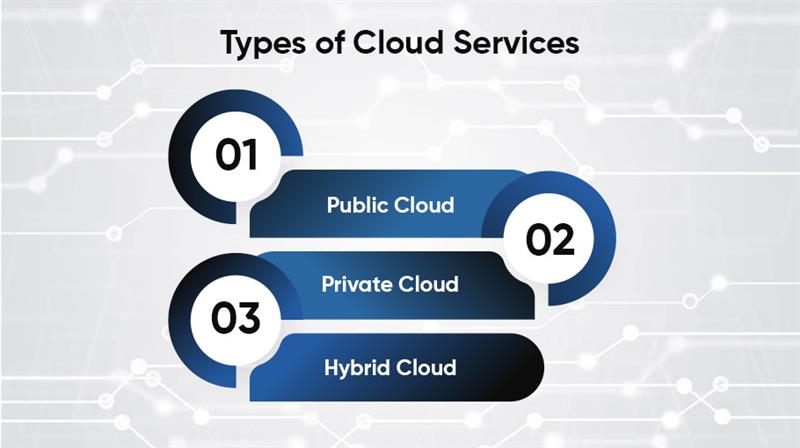
Cloud infrastructure isn’t one-size-fits-all. Depending on your needs, you can choose from a few different setups:
This is the most common and cost-effective option. Services are hosted on shared hardware, but data and access remain private. It’s like riding a bus—you share the ride, but you’ve got your own seat.
While a private cloud is exclusive to your company, it offers you the same freedom as a public cloud. Although it costs more, it is more secure and adaptable.
This combines public and private clouds, giving you the best of both worlds. You can keep sensitive data in your private cloud and use the public cloud for less critical workloads. It’s like having a gym membership and home equipment—you work out wherever it makes the most sense.
| Aspect | Hosted | Cloud |
| Deployment and Setup | Manual setup can take hours or days due to physical hardware. | Rapid deployment: environments may be created in minutes with a few clicks. |
| Cost Structure | Fixed monthly or annual pricing is predictable for budgeting. | Pay-as-you-go model: cost based on usage can add up if not monitored. |
| Flexibility and Scalability | Limited scalability; requires hardware upgrades or new contracts. | Highly flexible; scale up or down on demand with ease. |
| Security and Compliance | Full control is beneficial for regulated industries. | Strong security but shared responsibility; misconfigurations are a risk. |
| Maintenance and Support | Requires more in-house admin and support, especially for custom software. | Maintenance, updates, and security are mostly handled by the provider. |
If you require complete control over your environment, hosted infrastructure is a good option. It is best for companies that:
Industries such as banking, healthcare, and government frequently use hosted solutions. It gives them peace of mind and meets specific compliance mandates that cloud providers might not support out of the box.
If you’re a startup, SMB, or even a large enterprise going digital-first, the cloud is your best bet. It’s built for rapid development, constant changes, and scaling with ease. You should go to the cloud if you:
The cloud allows you to experiment, fail quickly, and pivot without being tied to physical hardware.
Let’s break it down simply:
It’s like comparing a mortgage to a utility bill. Hosted is stable and predictable. Cloud is flexible but requires careful monitoring.
Server specifications, load balancing, geographical dispersion, and other variables all have an impact on performance.
Because you are not sharing resources, hosted infrastructure often provides constant performance. However, if you outgrow your arrangement, you will have to update manually.
Cloud companies generally give higher overall uptime and speedier failover systems. They’re designed to withstand surges and immediately redirect traffic if a server fails. This means fewer surprises and improved business continuity.
Hosted environments are often easier to configure for strict compliance. You know where your data lives, and you control who has access.
With the cloud, things get a bit trickier. You need to make sure your provider complies with standards like HIPAA, GDPR, or PCI-DSS. Many do, but configuration errors on your side can still leave you vulnerable.
Data sovereignty—i.e., where your data is physically stored—is also a big deal. Hosted solutions let you choose. Cloud providers might store your data across borders.
The tech world doesn’t stand still. As AI, automation, and digital transformation take center stage, cloud platforms are evolving to support next-gen applications.
Hosted solutions are dependable, but they don’t scale easily with new technologies. Cloud platforms integrate faster with emerging tech and offer a smoother upgrade path.
If your business is planning for long-term growth and innovation, the cloud gives you the agility to adapt without overhauling your infrastructure every few years.
In the end, it comes down to what you need.
Ask yourself:
If your answer leans toward stability, control, and compliance—go hosted. If you need speed, flexibility, and cost-effectiveness—the cloud is your friend.
Choosing between hosted and cloud infrastructure is like choosing between a truck and a sports car—they both get you where you need to go, but how you get there (and what you carry with you) will vary.
Hosted infrastructure is great for control freaks, compliance-heavy industries, and businesses with legacy systems. Cloud infrastructure is ideal for innovators, entrepreneurs, and anybody who values speed, flexibility, and minimal start-up costs.
There is no universal solution, only the one that best suits your objectives. Take the time to examine your demands, plan for your future growth, and don’t be hesitant to combine both alternatives if that works best for you.


IT Solutions and Managed Services Provider specializing in developing custom solutions.
 +1 (781) 667-5321
 info@techmatter.co
 100 N Brand Blvd Suite 522, Glendale, CA 91203, USA