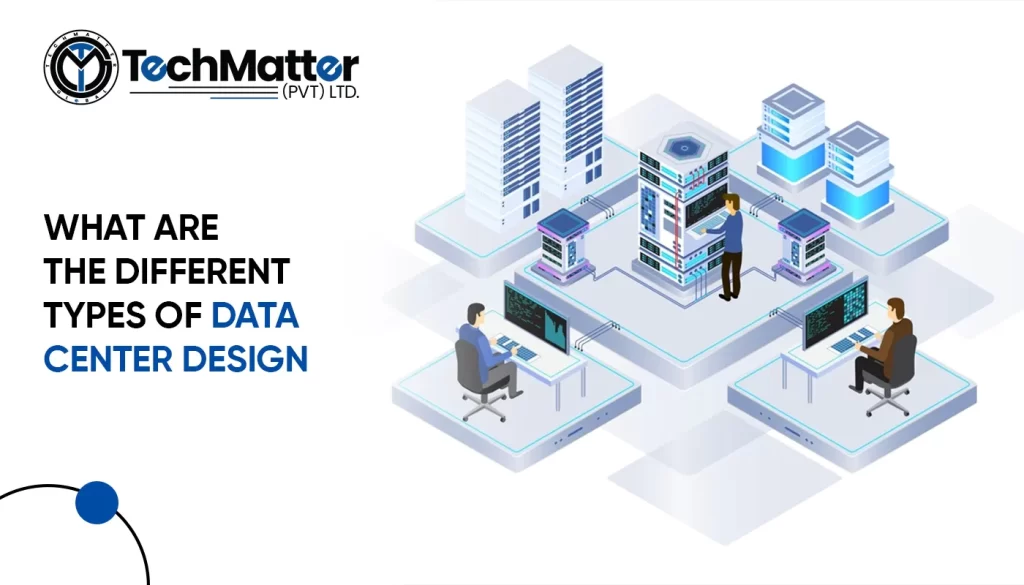
Businesses and other organizations rely on data centers to maintain their IT infrastructure and shelter and administer IT resources. Data centers must be built to accommodate the growing needs of contemporary computing as technology advances. The appropriate architecture for a data center may guarantee top performance and efficiency while keeping costs down. This article examines various designs and their pros and cons. We will also discuss what type is suitable for your business type.
The traditional data center is on-premises, meaning its features are physically located within a company’s workplace. It might be as little as a few computers beneath a desk, as large as an entire building loaded with blade servers in a climate-controlled room.
These are constructed using a three-tier infrastructure, with discrete blocks of computing, storage, and network resources allotted to support different applications. The three layers are integrated into a single building unit called a node in a hyper-converged infrastructure (HCI). A pool of resources that a software layer can handle can be created by combining many nodes.
Servers, firewalls, routers, storage systems, switches, and cybersecurity systems are frequently essential components in every data center. Servers are a fundamental element that all designs of architecture share.
| Advantages | Disadvantages |
|---|---|
| Security and Control: provide a high degree of infrastructure and data security and management. | High Expenditure: Creating and maintaining involves significant upfront capital expenditure. |
| Customizability: Organizations are free to modify and set up their infrastructure per their own requirements. | Limited Scalability: Possess a limited capacity for scalability, necessitating businesses to plan for future development and invest in surplus capacity. |
| Familiarity and Skill Set: The best practices and knowledgeable employees for this technology are readily available to organizations. | Disaster Recovery: Organizations must invest in redundant systems and backup solutions to reduce the risk of data loss or downtime due to unanticipated circumstances. |
| Disaster Recovery: Organizations must invest in redundant systems and backup solutions to reduce the risk of data loss or downtime due to unanticipated circumstances. | Energy Consumption: This usually requires a lot of energy to power and cool the infrastructure. |
| Data Storage: They can process and store data worldwide while remaining subject to local privacy laws, whether on their premises. | Time-Consuming: Establishing it from scratch can be a time-consuming process. |
An upgraded version of a traditional approach. This design is a portable collection of capacity components such as; servers, storage, and networking.
There are several benefits of a modular approach to offer flexibility to businesses. Modular design improves readability, maintainability, reliability, and quality. Parallel and collaborative work and module reuse can boost development productivity. The flexibility involves modules that can be sent to be incorporated, retrofitted, or merged into any system.
3 designs in the modular center approach are listed below:
Let’s have a look at how modular design assists in facilitating the following:
Modular Designs in Facilitating Scalability: The capacity to add or remove modules from a modular design facilitates scalability, making it easier to extend or alter systems.
Modular Designs in Facilitating Cost-efficiency: These designs use standardized components to speed up the design and building process while reducing costs.
Modular data centers speed up deployment times and improve flexibility by pre-configuring and integrating components.
Three real-life implementations are provided below:
In their Prineville facility, which is located in Oregon, the United States, Facebook created modular data centers. These data centers are constructed as discrete modules that may be added or eliminated depending on the needs of the business. The modular structure makes scaling up and deploying more computer power simple.
Microsoft’s Project Natick aims to create modular data centers. These data centers are located underwater in specially constructed containers. Utilizing the water’s inherent cooling abilities, this new method boosts efficiency while consuming less energy.
Fusion Module, a modular infrastructure solution from Huawei, provides high-density computing in a small package. These data centers may be quickly set up and customized to fit specific needs. The modular design provides for greater energy efficiency and practical space usage.
Like a cloud-based deployment approach, a company leases space from a third-party provider. In contrast to the cloud, a firm’s servers and network infrastructure are privately owned and managed by that company.
Usually, redundant power and internet connections are provided. For disaster recovery, colocation companies could provide mirrored data centers. Colocation providers frequently offer High-end physical security features, which may be expensive for an internal design.
Retail, wholesale, and hybrid cloud-based colocation are the three primary categories of a colocation facility.
When you lease space for retail colocation, you generally rent a rack, a section inside a rack, or your caged-off room inside the infrastructure.
Wholesale colocation offers space at a reduced cost. Because of this, the data center’s power and space to run your equipment are less than what the it would offer to a retail customer.
Combining your data center space with space you rent from another is called hybrid cloud colocation.
Businesses can leverage critical features and services such as scalable power and cooling solutions, redundant network connectivity, physical security measures, and 24/7 monitoring and support to relieve the burden of managing their own data centers.
A hyper-scale is a crucial infrastructure accommodating robust and scalable workloads. Large businesses with significant data processing and storage needs, including Google, Amazon, Microsoft, Facebook, and Apple, are frequently linked to hyper-scale designs.
There are some challenges associated with the hyper-scale approach.
Continuity and dependability are two of the greatest challenges that hyper-scale infrastructures encounter. These words are frequently used in service or “uptime” contexts. The more consistent and reliable the service is, the greater the reliability.
Hyperscale approach can accommodate more servers than traditional approach, making it simple to disperse workloads over several systems and prevent overheating of a single server, increased energy effectiveness. Large-scale hyper-scale designs may use a lot of power.
AWS has several hyper-scale architectures worldwide, including big ones in Northern Virginia. They have transformed the IT industry by providing on-demand computing capabilities that allow organizations to overgrow and accelerate the creation of cloud-based apps and services.
Edge computing is a distributed information technology (IT) architecture where customer data is handled at the network’s edge, as near the original source as feasible.
In today’s technological landscape, it holds great importance. Organizations can process data locally instead of sending it to a centralized location, enhancing application performance, cost savings, and response times.
This design come in two primary categories. The first is a modest facility that a service or colocation provider uses to serve secondary sites. At the same time, the second is a modularized site located close to the edge of an organization’s leading network.
It significantly improves latency reduction and support for real-time applications by putting computer resources closer to the end users. Due to the reduced network traffic and quicker data processing made possible by this proximity, reaction times are shorter, and latency is decreased.
Here are some challenges to that you may know before choosing an edge design for your business:
Conclusion:
If businesses want to create an adequate IT infrastructure, they must have a solid understanding of the various kinds of designs. Companies can ensure that their systems operate effectively, are efficient, and readily grow as needed by carefully reviewing and selecting the best design. This results in more efficient operations and allows the company to expand successfully.


IT Solutions and Managed Services Provider specializing in developing custom solutions.
 +1 (781) 667-5321
 info@techmatter.co
 100 N Brand Blvd Suite 522, Glendale, CA 91203, USA